AI in Script Analysis: Global Market Insights

- I Spent $90 on AI Analysis - Here's Why It Nearly Ruined My Script
- Global Market Trends in AI Script Analysis Tools
- How AI Identifies International Market Potential in Scripts
- Case Studies: AI's Impact on Studio Script Acquisition
- The Future of AI in Script Analysis
- FAQs
AI is transforming how the film industry evaluates scripts, replacing intuition with data-driven decisions. Studios are using AI tools to analyze scripts faster, predict global appeal, and reduce risks. Here's what you need to know:
- Market Growth: The global AI entertainment market is projected to grow from $17.1 billion in 2023 to $195.7 billion by 2033.
- Speed and Precision: AI evaluates scripts in minutes, assessing narrative structure, character depth, and market potential.
- Global Appeal: AI identifies scripts likely to succeed internationally by analyzing cultural factors and past box office data.
- Cost Efficiency: Tools like AIScriptReader offer script evaluations starting at $29, making them accessible to independent filmmakers and studios alike.
- Impact: Studios using AI have seen reduced flops and faster decision-making, enabling better investments.
AI is reshaping the entertainment industry by helping studios make smarter, faster, and more informed decisions about which scripts to produce.
I Spent $90 on AI Analysis - Here's Why It Nearly Ruined My Script
Global Market Trends in AI Script Analysis Tools
The growth of AI-powered script analysis tools is nothing short of extraordinary. What started as an experimental concept has now evolved into a $73.98 billion market in the United States by 2025. This rapid rise underscores how studios and production companies are increasingly relying on AI to make smarter, faster decisions.
The overall AI market is also gaining momentum. By 2024, 78% of organizations reported using AI, a sharp increase from 55% the previous year. This surge has pushed studios to embrace AI for more efficient and accurate script evaluations, reflecting broader trends across industries.
Market Growth and Adoption Numbers
The AI-generated movie script market is on track to hit $11.1 billion by 2033, climbing at an impressive compound annual growth rate of 28.7% from 2025. This makes it one of the fastest-expanding sectors in entertainment technology.
North America leads the market, accounting for the largest revenue share in 2024. This dominance is fueled by Hollywood's early adoption of AI tools and significant venture capital investments in entertainment tech startups. Meanwhile, the Asia Pacific region is seeing the fastest growth. Countries like China, India, and South Korea are driving this expansion, as their booming media and entertainment industries increasingly use AI to create content tailored to local audiences.
Globally, AI adoption is anticipated to rise by 20%, reaching 378 million users in 2025. For the entertainment sector, this means that advanced AI script analysis tools are becoming accessible to a wider range of professionals, not just major studios. The rise of cloud-based solutions is a key factor here, enabling cutting-edge analysis without the need for massive initial investments.
AI and Machine Learning as Market Drivers
While the numbers are impressive, the real story lies in the technology driving this growth. Advances in AI are shaping the next phase of script analysis, making tools more powerful and precise.
Key breakthroughs include Natural Language Processing (NLP), which allows AI to interpret subtle nuances in scripts, evaluate dialogue quality, and flag grammatical issues that could impact production. Machine Learning algorithms are now capable of predicting successful storytelling patterns by analyzing extensive databases of scripts and their box office outcomes. On top of that, Deep Learning and Neural Networks are enabling AI to maintain a cohesive understanding of entire screenplays, ensuring that individual scenes align with the overall narrative.
Recent innovations highlight this progress. For instance, in March 2025, OpenAI added an advanced image generator to GPT-4o, capable of creating visually stunning and practical images with precise text rendering. Additionally, the rise of domain-specific AI models - trained specifically on screenwriting norms and market data - has resulted in tools that provide more accurate and actionable insights.
The shift toward multilingual large language models with an understanding of cultural nuances is particularly noteworthy. These tools help studios assess how scripts might resonate across different languages and regions, aiding smarter global distribution decisions. For example, AI can predict how well a script might perform in international markets before production even begins.
With 83% of companies prioritizing AI in their business strategies, the integration of AI into core operations is no longer optional - it's essential. From faster processing to predictive analytics and cultural awareness, these advancements are redefining how scripts are evaluated and developed in the entertainment industry.
How AI Identifies International Market Potential in Scripts
When studios pour millions into a project, they need precise insights into how it will perform internationally. AI tools are stepping up to provide these insights, offering advanced methods to evaluate scripts for their global appeal. These tools go beyond basic text analysis, using data-driven techniques to predict box office performance across different markets with impressive precision. Let’s dive into how AI achieves this.
AI Methods for Script Evaluation
AI has revolutionized script evaluation through Natural Language Processing (NLP), which breaks down scripts into measurable components. By analyzing character interactions, scene structures, and dialogue flows, AI identifies the narrative elements that resonate most with audiences.
The process doesn’t stop at surface-level analysis. AI evaluates key aspects like:
- Dialogue quality and pacing: Identifying how well-written and engaging the conversations are.
- Emotional resonance: Pinpointing moments likely to spark specific reactions from viewers.
- Character archetypes and plot structures: Comparing these elements to patterns found in successful films.
For example, ScriptBook’s algorithm assesses scripts against 220 parameters. These include everything from character development trends to dialogue structures that have historically succeeded in international markets. This level of detail helps studios gauge a script’s potential appeal across different cultures and demographics.
Predicting Box Office Success with AI
AI doesn’t just analyze scripts - it predicts their financial success. By combining script analysis with market intelligence, AI models provide studios with forecasts of a film’s global box office performance.
Key metrics used in these predictions include:
- Historical box office data: To identify patterns and trends.
- Social media buzz: Measuring audience anticipation and interest.
- Audience demographics: Understanding which groups are likely to connect with the story.
AI also factors in pre-release indicators and compares new scripts to similar films, analyzing their performance trajectories. It even evaluates budgets and talent metrics to refine financial forecasts. Using techniques like regression analysis, classification, and neural networks, these models offer studios a comprehensive view of a script’s market potential.
For instance, AI tools can highlight themes and tones, compare script elements to a database of over 760,000 titles, and predict audience reactions. This detailed analysis helps studios anticipate returns on investment while minimizing risks tied to poor market performance.
How AI Insights Reduce Studio Risks
When entering global markets, reducing risk is a top priority. AI-driven script analysis has become a game-changer in helping studios make smarter investment decisions. By identifying weak scripts early, AI prevents costly missteps.
The impact is tangible. Warner Bros., for example, saw a 20% decrease in box office flops after incorporating AI into their selection process. Additionally, AI speeds up script evaluations significantly. Paradigm Talent Agency’s Prescene tool reduced script coverage time by over 95%, enabling agents to review 30% more scripts per week.
Beyond financial risks, AI also protects studios from legal pitfalls. With over 95% accuracy, these tools can flag potential copyright issues, ensuring smoother international distribution. AI further aids in localization, translating and adapting scripts for different languages and cultural contexts without compromising the story’s essence.
In one standout case, AI identified a script that human evaluators had overlooked. The resulting film ended up earning 30% more ROI than expected. By offering objective evaluations, AI balances out the subjectivity of human judgment, especially when assessing content for unfamiliar markets.
sbb-itb-44d62f7
Case Studies: AI's Impact on Studio Script Acquisition
The true measure of AI's influence on script analysis lies in its real-world application. Across the globe, studios are discovering how AI tools are reshaping script acquisition, leading to smarter decisions and better returns on international projects.
AIScriptReader: A Game-Changer for Script Development
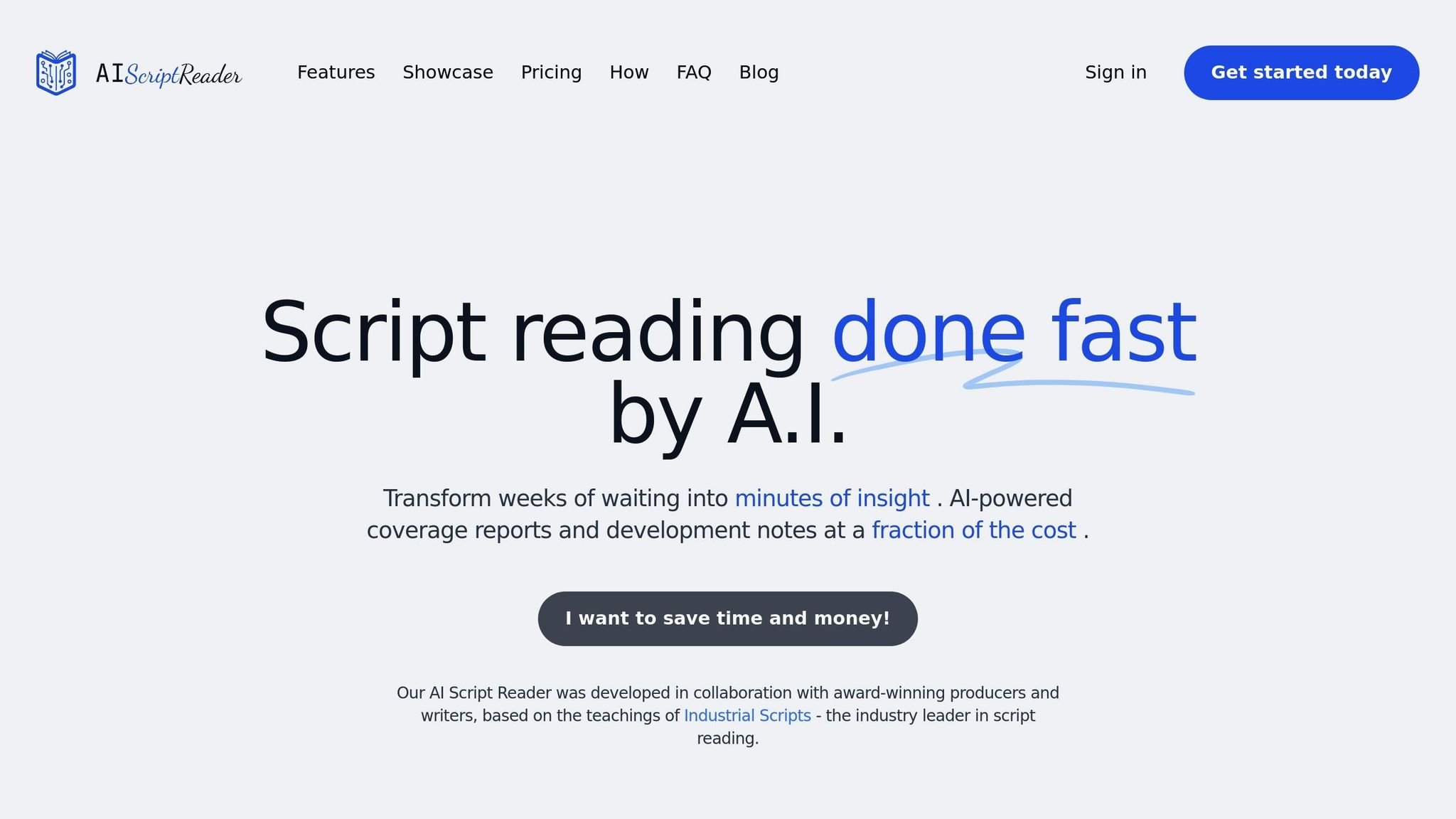
With global market trends heavily influencing studio strategies, AIScriptReader has emerged as a valuable tool for script development. Its Coverage Reports offer clear evaluations of a script's strengths, weaknesses, and overall market potential. Meanwhile, its Development Notes provide actionable feedback to refine scripts for success.
Studios using AIScriptReader gain insights into critical factors for international appeal, such as genre preferences, audience targeting, and adaptation possibilities. The platform’s executive-level coverage also highlights market viability, estimated budgets, and tailored marketing strategies, giving decision-makers a comprehensive view of a script's potential.
The process is straightforward: upload a script, let the AI analyze it, and receive a detailed report. This streamlined approach allows studios to evaluate more scripts without needing additional staff. At $39 for a single Coverage Report or $69 for both Coverage and Development Notes, AIScriptReader offers a budget-friendly way to maintain high-quality evaluations.
What makes AIScriptReader stand out is its commitment to impartiality. By removing personal bias, the platform provides objective assessments, helping studios avoid costly mistakes when selecting scripts for international markets. Its ability to identify recurring themes and compare scripts to successful global hits gives studios the confidence to make informed distribution decisions.
Studio Success Stories with AI Integration
The value of AI in script acquisition is evident in the success stories of studios leveraging this technology. One striking example involves an overlooked script that AI identified as a hidden gem. This script, initially dismissed by human evaluators, resulted in a film that delivered a 30% higher ROI than anticipated, showcasing AI's knack for spotting untapped potential.
Industry professionals have praised the efficiency and clarity of AI-driven analysis. One veteran remarked:
"In 15 years of writing and reading coverage, I have never seen such helpful analysis turned over with such speed."
Sterling & Stone also highlights the confidence AI brings to global market decisions. Niamh Arthur, Head of Development, shared her experience:
"It really gave me a sense of excitement and relief... [the AI] is like this friend, a buddy that has our back."
Sean Platt, the company’s founder, emphasized the financial and strategic benefits of AI validation:
"It was great to see that our intentions were mapped and that gives us a lot of confidence because guessing is expensive... We have the ability [now] to validate our ideas globally."
With prices starting at $29 per script or $59 per month for multi-script analysis, AI evaluations are far more affordable than traditional coverage fees. Plus, AI tools slash analysis time from days to mere minutes, offering a turnaround that’s over 20 times faster. This speed allows studios to act quickly on promising opportunities, often beating competitors to the punch.
These examples show a clear trend: studios that incorporate AI into their script acquisition process gain an edge through faster decisions, lower costs, and sharper accuracy in identifying scripts with global market potential. As AI continues to evolve, its role in script selection is only set to grow stronger.
The Future of AI in Script Analysis
As global markets reshape film production strategies, AI is revolutionizing how scripts are analyzed. Soon, AI will be a cornerstone for studios aiming to make smarter, data-driven decisions in the entertainment industry. Here's a closer look at the key shifts shaping this transformation.
Key Takeaways for Filmmakers and Studios
AI-powered script analysis is proving to be a game-changer, delivering insights that traditional methods simply can't replicate. For instance, predictive models now boast up to 90% accuracy in forecasting box office success, giving studios a level of foresight that was previously unattainable.
AI's integration into global projects is no longer a novelty - it's the norm. Streaming platforms have already seen a 20% increase in user engagement thanks to AI-driven recommendation engines that personalize content based on individual viewing habits.
The financial benefits are equally striking. Tools like AIScriptReader offer professional-grade script analysis at a fraction of the cost, making it accessible to independent filmmakers and major studios alike. By leveling the playing field, these tools are empowering a broader range of storytellers to compete in the global arena.
Studios venturing into international markets should also focus on AI tools that provide cultural compliance analysis. These tools help avoid potential missteps by ensuring content aligns with regional norms and sensitivities. Additionally, AI-powered dubbing, subtitling, and localization solutions are enabling faster and more cost-effective entry into global markets.
These advancements highlight how AI is reshaping the industry, setting the stage for even more transformative changes.
Upcoming Changes in AI Script Analysis
The AI in Film Market is on a rapid growth trajectory, projected to surge from $1.8 billion in 2024 to $14.1 billion by 2033, with a compound annual growth rate (CAGR) of 25.7%. This explosive growth underscores the industry's recognition of AI's potential and hints at the arrival of more advanced tools.
One of the most exciting developments is Cultural AI, which is poised to redefine script analysis by tailoring content to the unique preferences, values, and traditions of different audiences. This capability will help studios craft stories that resonate on a global scale.
Real-time decision-making is another breakthrough. AI systems can now analyze live footage and provide immediate feedback on elements like lighting and actor performance. Soon, this real-time analysis will extend to script development, offering instant insights into dialogue, pacing, and character arcs.
Generative AI tools are also expanding creative horizons. From scriptwriting to storyboarding and visual effects, these tools are giving writers and studios new ways to explore narratives and visualize ideas before committing significant resources.
As immersive technologies like VR and AR gain traction, AI script analysis tools are evolving to evaluate content tailored for these formats. This shift is paving the way for more engaging and interactive storytelling.
Global market trends are pushing AI tools to adapt to a wider range of storytelling traditions. While North America currently dominates the AI-Generated Movie Script market, the Asia Pacific region is expected to grow at a remarkable CAGR of 32.1% between 2025 and 2033. This indicates a future where AI tools will need to cater to diverse cultural narratives and preferences as markets expand.
The future of AI in script analysis isn't just about technological advancements. It's about building a more inclusive and globally attuned entertainment industry that delivers compelling stories to audiences everywhere.
FAQs
How does AI enhance the efficiency and accuracy of script evaluations in the film industry?
AI has transformed how scripts are evaluated by diving into crucial aspects like structure, character arcs, and market appeal with impressive accuracy. Advanced algorithms can even estimate a script's chances of success with up to 90% accuracy, giving studios and filmmakers actionable insights that were once harder to obtain.
Beyond accuracy, AI dramatically speeds up the evaluation process. Tasks that used to take days - or even weeks - can now be wrapped up in mere minutes. This allows industry professionals to make quicker, data-informed decisions, all while streamlining their creative workflows.
What factors does AI analyze to determine a script's global appeal?
AI takes into account several important factors when determining a script's potential to succeed on a global scale. These factors include current trends in the international market, regional audience preferences, and how well the script aligns with different cultural contexts. It also examines storytelling aspects such as universal themes, relatable characters, and the popularity of specific genres to estimate its appeal to a wider audience.
Using predictive analytics, AI offers studios valuable insights to pinpoint scripts that are likely to connect with diverse viewers. This approach helps simplify and improve the decision-making process for selecting projects with global appeal.
How do AI tools like AIScriptReader help independent filmmakers save money and reach wider audiences?
AI tools like AIScriptReader give independent filmmakers an affordable way to break down scripts by automating tedious tasks. They can quickly identify a script's strengths, weaknesses, and market potential - cutting out the need for costly manual reviews and saving both time and resources.
These tools also offer insights into global market trends and audience preferences, helping filmmakers shape stories that resonate with wider audiences. By delivering practical feedback, AIScriptReader equips creators to fine-tune their scripts and boost their chances of impressing studios or investors.
Free Screenwriting Tools
Tools to use alongside your writing — no signup, no cost.
Free Screenplay Editor
Write and auto-format scripts in your browser. Cloud autosave, PDF & Fountain export.
Open tool →AI Script Breakdown
Upload a script and every scene is tagged with its production elements. $29 per script.
Open tool →Get a Full Coverage Report — $39
AI screenplay coverage and development notes in minutes. No subscription.