AI in Script-to-Screen Workflow
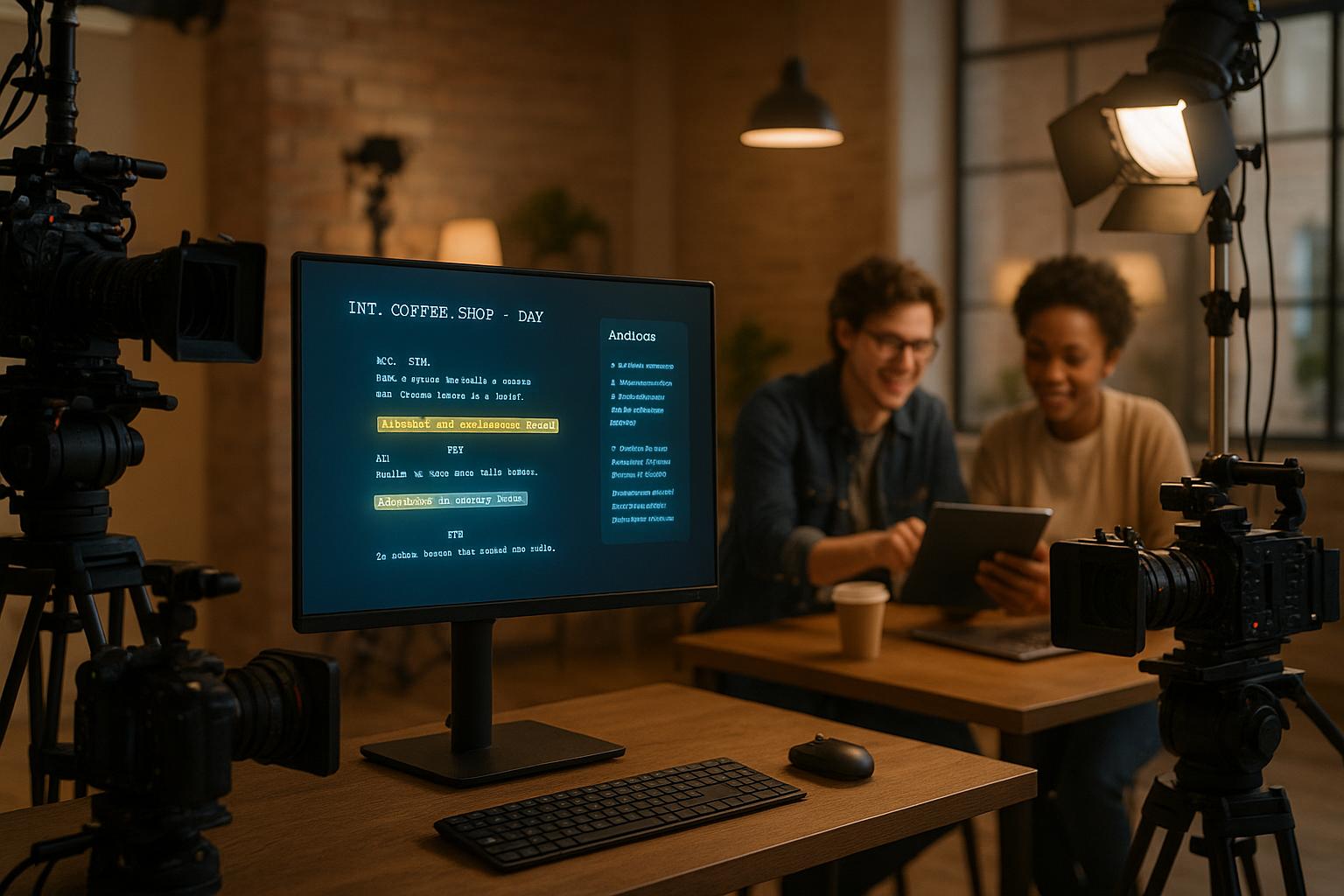
- Gen AI Workflows for Film and TV Production
- AI-Powered Script Analysis and Feedback
- How AI Ensures Continuity and Consistency
- Adding AI to Film Production Workflows
- Future Trends and Best Practices for AI in Filmmaking
- Conclusion
- FAQs
- How does AI help maintain continuity and consistency in film production, and what are its key benefits?
- How can AI-generated coverage reports and development notes streamline script evaluation for filmmakers?
- What are the latest AI trends in filmmaking, and how are they shaping the script-to-screen process?
- How AI is Transforming Filmmaking
AI is transforming how movies are made, speeding up processes, cutting costs, and reducing errors from scriptwriting to post-production. Key highlights include:
- Script Analysis: AI tools analyze scripts in hours instead of days, improving script selection by 25% and reducing revisions by 35%.
- Continuity Management: Automated systems track props, lighting, and dialogue, preventing costly mistakes and reshoots.
- Production Planning: AI generates schedules, budgets, and breakdowns automatically, saving time and ensuring precision.
- Post-Production: Tasks like sound design, color grading, and editing are streamlined with AI, enhancing efficiency.
Gen AI Workflows for Film and TV Production
AI-Powered Script Analysis and Feedback
AI's role in filmmaking doesn't stop at production - it’s also reshaping how scripts are analyzed and refined. Tasks that once took weeks are now completed in hours, with AI providing filmmakers and studios with fast, objective feedback.
How AI Streamlines Script Analysis
AI can now evaluate a script in just two hours, compared to the ten days it used to take. It identifies key elements like plot points, character arcs, and themes with impressive accuracy. Plus, its evaluations are consistent, removing the subjective variability often found in human assessments.
Studios that incorporate AI into their script analysis processes are seeing tangible results. Data shows a 25% improvement in script selection accuracy, a 35% reduction in revision cycles, and a 30% cut in development costs. This is especially impactful in an industry where only a tiny fraction of scripts - less than 1% - receive a "Recommend" rating. By offering data-driven insights, AI tools help writers understand exactly where their work stands, making it easier to navigate the competitive world of filmmaking.
This swift, unbiased analysis paves the way for even more detailed feedback through AI-generated reports.
Coverage Reports and Development Notes
AI-generated coverage reports and development notes are game-changers for script evaluation. These tools rely on industry data rather than personal reader opinions, ensuring consistency in their assessments. They dive into the script’s narrative structure, character development, dialogue quality, and thematic elements.
For example, Paradigm Talent Agency reported a 95% reduction in coverage time after adopting AI tools. This efficiency allowed their team to review 30% more material each week, significantly expanding their capacity without increasing staff.
AI also acts as an early warning system, flagging potential copyright issues before they become costly problems. By catching these concerns early, creators can make adjustments while changes are still affordable and manageable.
Film festival founder and writer Matisse Tolin highlighted the transformative impact of AI on his workflow:
"In my fifteen years of writing and reading coverage, I have never seen such helpful analysis turned over with such speed." - Matisse Tolin, film festival founder and writer
Unlike human readers, AI can detect trends and patterns in scripts that might otherwise go unnoticed. It offers objective, data-backed insights that support creative decisions while eliminating the risk of human bias. This ensures every script is evaluated on equal footing.
One standout example of this technology in action is AIScriptReader, which has become a leader in AI-driven script analysis.
AIScriptReader: A Case Study in Script Analysis
AIScriptReader provides two main services for industry professionals: Coverage Reports and Development Notes.
- Coverage Reports offer a concise breakdown of a script’s strengths, weaknesses, and market potential. They include loglines, synopses, and detailed evaluations in line with industry standards.
- Development Notes go further, delivering actionable feedback to help writers improve their scripts. These notes don’t just highlight what needs fixing - they also provide clear, practical advice on how to address those issues.
The platform is simple to use: upload your script, let the AI analyze it using advanced algorithms, and receive a comprehensive report. This streamlined process eliminates the delays often caused by back-and-forth communication and scheduling conflicts.
AIScriptReader also prioritizes security and confidentiality, ensuring that scripts are handled with care. Its user-friendly dashboard makes managing multiple projects easy, while the AI-generated reports maintain the quality and detail that writers and producers rely on.
Pricing is straightforward: a Coverage Report costs $39, and adding Development Notes brings the total to $69. This affordable model makes high-quality script analysis accessible to independent filmmakers and smaller productions that might not have the resources for traditional coverage services.
How AI Ensures Continuity and Consistency
AI has become an invaluable tool in ensuring continuity and consistency on film and television sets. Maintaining continuity during production is no small feat - something as seemingly minor as a character's name changing mid-script or a misplaced prop can throw off the entire narrative. Modern AI tools are designed to catch these issues early, smoothing out potential disruptions and ensuring a seamless story from start to finish.
How AI Detects Continuity Errors
One of AI's standout abilities is its knack for identifying inconsistencies that might slip through traditional script reviews. These tools dive deep into scripts, analyzing everything from plot coherence and character development to timeline accuracy. They flag gaps in the story or inconsistencies in character arcs before production even begins, saving filmmakers significant headaches down the line.
AI doesn’t stop there. It tracks character arcs across scenes, scrutinizing the sequence of events, dialogue, and timing to ensure everything aligns. Once filming is underway, AI tools step up even further by recording dialogue and ambient sounds, transcribing them, and comparing the results to the original script. If something doesn’t match - like an actor delivering a line differently, a prop being out of place, or a character standing in the wrong position - AI flags it in real time. This allows directors to address issues on the spot, avoiding costly fixes later.
Television productions, in particular, benefit from AI’s ability to maintain consistency across episodes. For instance, Paradigm Talent Agency reported that AI-powered tools cut their teleplay review process from days to just minutes, allowing for rapid feedback on scripts and submissions. These tools also assist with script breakdowns, making the entire production process more efficient.
AI-Assisted Script Breakdowns
Script breakdowns are another area where AI shines. Traditionally, breaking down a script - categorizing every character, location, prop, and special effect - requires hours of manual effort. AI automates this process, producing detailed breakdowns quickly and accurately. This is especially helpful for complex scenes, like action sequences or large crowd shots, where production teams need organized data to plan resources effectively.
For television series, AI also ensures that the tone and style remain consistent across episodes. By referencing the show’s established guidelines, often outlined in a "show bible", AI catches deviations that might otherwise go unnoticed, preserving the narrative voice that audiences expect.
How AI Reduces Production Costs and Errors
Continuity errors don’t just disrupt the story - they can also result in expensive reshoots and post-production fixes. By identifying and resolving inconsistencies early, AI helps production teams avoid these costly setbacks. Real-time error detection means issues are addressed while they’re still manageable, reducing the need for time-consuming edits and re-filming. This proactive approach saves both time and money, making AI an indispensable part of modern filmmaking.
Adding AI to Film Production Workflows
Transitioning from script analysis to production used to involve a lot of manual effort and coordination. Today, AI is reshaping this process by seamlessly connecting the creative and logistical aspects of filmmaking, merging what were once separate tasks into a unified workflow.
From Script Analysis to Production Planning
AI has revolutionized the way scripts are translated into production requirements. It can now generate detailed breakdowns for scheduling, budgeting, and resource allocation automatically. For instance, tools like Filmustage simplify scheduling by automating time estimates, tagging real locations, and producing call sheets automatically. Similarly, Saturation.io handles financial tracking, optimizes expenses, and delivers precise budget forecasts.
Take AIScriptReader as an example - it analyzes scripts to identify key elements like characters, locations, and props. The data it generates feeds directly into production planning systems, helping to define resource needs, scheduling constraints, and budget considerations. This streamlined data flow reduces errors and minimizes unexpected delays, making the entire process more efficient.
AI-based scheduling tools take it a step further by optimizing task sequencing and resource allocation in real time. If sudden issues arise - like bad weather or a key team member becoming unavailable - AI can instantly recalculate schedules, reassign resources, and update budgets.
Additionally, real-time AI data ensures that script revisions, scheduling updates, and budget changes are shared immediately across departments. These automated updates keep everyone on the same page and inform production decisions as they happen.
Manual vs. AI-Driven Workflows Comparison
Here’s a quick look at how AI stacks up against traditional methods:
| Feature | Manual Workflow | AI-Driven Workflow |
|---|---|---|
| Speed | Takes days or weeks to break down scripts and schedule | Cuts script analysis time by 50%; schedules ready in hours |
| Accuracy | Prone to human error and inconsistencies | Offers precision with real-time error detection and corrections |
| Labor Intensity | Requires significant manual effort across teams | Reduces shift-filling time by 83%; automates task distribution |
| Cost | Higher due to time investment and error correction | Cuts costs through better resource allocation |
| Scalability | Limited by human capacity and complex coordination | Can manage multiple projects simultaneously with ease |
The numbers speak for themselves. AI tools can reduce script analysis time by half, create schedules 50% faster, and cut shift-filling time by 83%. This level of efficiency not only speeds up production but also improves accuracy and adaptability, minimizing the need for multiple revisions.
Scalability is another major advantage. While traditional workflows require dedicated teams for each project, AI systems can handle several productions at once by sharing resources and insights across projects. This gives smaller studios a chance to compete with larger ones by leveraging these efficiencies.
However, the move to AI isn’t just about replacing manual processes - it’s about integrating AI strategically. While over half of producers recognize AI's potential to improve production and cost management, only about a quarter have fully embraced it. The key to success lies in balancing AI’s efficiency with human creativity and judgment. AI excels at crunching data, spotting patterns, and automating repetitive tasks, but human expertise remains critical for creative decisions, building relationships, and navigating unexpected challenges.
sbb-itb-44d62f7
Future Trends and Best Practices for AI in Filmmaking
AI has already cemented its role in filmmaking by enhancing continuity and streamlining production processes. Now, the focus shifts to how emerging trends and best practices will shape the industry's future. AI isn't just a tool - it's opening up new creative avenues. As Brett Stuart, head of AI filmmaking at Staircase Studio, puts it:
"AI in filmmaking isn't some theoretical 'someday' concept anymore - it's already here, and it's weirdly good".
New AI Trends in Film Production
The latest advancements in AI are setting the stage for a transformative era in filmmaking, building on its current capabilities.
- Generative AI for digital visualization: Directors can now create digital storyboards and mood boards quickly and affordably, eliminating the need for costly physical setups.
- Multi-model AI pipelines for post-production: Specialized AI models are being chained together like creative plugins, handling tasks such as voice synthesis, rotoscoping, and automated color grading. This approach is revolutionizing workflows.
- Dynamic storytelling with adaptive scripts: AI is stepping into the writer’s room, co-writing screenplays, generating alternate scenes, and enabling branching narratives. This paves the way for interactive and nonlinear storytelling, where audiences can explore multiple outcomes.
- AI-generated digital environments: Virtual production is becoming more accessible, allowing independent filmmakers to create visually stunning worlds without the need for massive budgets.
One standout example of these trends is prompt-first filmmaking. In 2023, Waymark released "The Frost", a 24-minute post-apocalyptic film created entirely with AI. The team used OpenAI's DALL-E 2 to generate every shot from a script, while other AI tools animated the still images.
Elizabeth Strickler, Director of Media Entrepreneurship and Innovation Programs at Georgia State University, highlights the broader impact of these advancements:
"For filmmakers in 2025, AI isn't just changing how movies are made - it's changing who gets to make them".
Best Practices for Using AI in Film
As AI reshapes filmmaking, following best practices ensures it enhances creativity without compromising artistic integrity.
-
Keep creative control: Use AI as a tool to expand your vision, not replace it. As Elizabeth Strickler advises:
"Like all art, using AI effectively requires intention, authenticity and alignment with the essence of the work".
- Define intellectual property rights: Clearly establish ownership and credit for AI-generated content. Implement safeguards to prevent misuse or unauthorized use of creative works.
- Address bias proactively: Train AI on diverse datasets and conduct regular audits to identify and reduce biases. Diverse teams in development can also promote more inclusive representation.
-
Be transparent about AI usage: Communicate how AI is used throughout production and validate data inputs to avoid biases. Stephen McClelland, Digital Strategist at ProfileTree, underscores this point:
"The core of responsible AI lies in transparency and the rigorous validation of data inputs to mitigate inherent biases".
- Secure sensitive data: Follow strict security protocols and comply with data protection regulations. Documenting data sources ensures traceability.
- Balance automation with human expertise: Let AI handle repetitive tasks, freeing creative professionals to focus on high-value work. Training teams and fostering collaboration can ensure AI complements rather than replaces human talent.
-
Stay informed and ethical: Keep up with new technologies while prioritizing ethical practices. Brett Stuart reminds us:
"The best stories will always come from talented writers and directors. AI can provide tools to enhance storytelling, but it cannot replace human imagination, experience, or artistic vision".
The future of filmmaking lies in blending human creativity with AI's capabilities. By following these practices, filmmakers can embrace AI's potential while preserving the emotional depth and artistry that define great cinema.
Conclusion
AI is reshaping the entire journey from script to screen, boosting efficiency and creativity at every step of the filmmaking process. Today, 48% of film professionals are already leveraging AI for tasks like scriptwriting, casting, and editing, and the generative AI market in creative industries is projected to exceed $6 billion by 2025.
One of AI’s most striking contributions lies in ensuring continuity and consistency. It automates intricate tasks like color correction, sound design, and special effects, all while maintaining precision throughout production. Tools such as AIScriptReader offer detailed script analysis through features like Coverage Reports and Development Notes, helping filmmakers make informed decisions. Beyond production, AI enhances audience engagement with personalized experiences and targeted marketing strategies. This streamlined approach not only reduces costs but also opens the doors for more people to participate in filmmaking.
AI is also lowering barriers to entry, making the art of filmmaking more accessible. As Jane Rosenthal, Co-founder and CEO of Tribeca Enterprises, explains:
"Technology does not create a good story - humans do. But because of these technological innovations and new tools, the barrier to entry has shifted and there is room for everyone at the table".
The future of cinema lies in the partnership between human ingenuity and AI’s capabilities. While AI can churn out content at scale and deliver valuable insights, it lacks the emotional nuance that defines truly memorable storytelling. Bob Shaye, Founder of New Line Cinema, aptly puts it:
"AI might give you 10,000 variations of a script, but only a human knows how to make the audience cry at the right moment".
With these advancements, the script-to-screen process has transitioned from a rigid, manual workflow to a dynamic, AI-enhanced system that amplifies human creativity without losing emotional depth. As the motion picture industry is expected to grow to nearly $46 billion by 2027, filmmakers who embrace AI as a collaborator will be better equipped to craft stories that resonate deeply. By blending AI’s efficiency with the emotional insight of human creators, the future of cinema promises to be both innovative and deeply moving.
FAQs
How does AI help maintain continuity and consistency in film production, and what are its key benefits?
AI has become an essential tool for ensuring continuity and consistency in film production. It meticulously tracks and analyzes crucial details like scene setups, prop placements, character positions, and even background elements. This meticulous oversight helps keep the visual and narrative flow seamless across the entire production.
By automating these responsibilities, AI reduces the risk of human error, cuts down on expensive reshoots, and helps avoid delays in the production schedule. The result? A more efficient process, lower costs, and a smoother workflow - giving filmmakers the freedom to prioritize creativity and storytelling.
How can AI-generated coverage reports and development notes streamline script evaluation for filmmakers?
AI-generated coverage reports and development notes make evaluating scripts easier by offering quick and precise insights into a screenplay's strengths, weaknesses, and market appeal. This helps filmmakers make faster, well-informed decisions during the development process.
By automating the often time-intensive task of analysis, these tools provide consistent and unbiased evaluations. This means filmmakers can spend more time focusing on refining their creative vision while keeping projects on track. It’s a practical way to boost efficiency and support stronger storytelling.
What are the latest AI trends in filmmaking, and how are they shaping the script-to-screen process?
How AI is Transforming Filmmaking
AI is reshaping the filmmaking process, offering tools that simplify and enhance every step from pre-production to post-production.
During pre-production, AI takes on tedious tasks like script analysis, budgeting, and scheduling. By automating these processes, filmmakers can focus more on creativity while saving both time and resources.
On set, AI-powered tools support production by analyzing scenes for continuity and consistency. This means fewer reshoots and smoother workflows, giving directors and crews more confidence in their daily progress.
Post-production is where AI truly shines. It’s driving advancements in visual effects, CGI, and even automated editing. These tools not only speed up the process but also deliver results that look more polished and lifelike.
By streamlining workflows and sparking new creative opportunities, AI is paving the way for a more efficient and imaginative future in filmmaking.
Free Screenwriting Tools
Tools to use alongside your writing — no signup, no cost.
Free Screenplay Editor
Write and auto-format scripts in your browser. Cloud autosave, PDF & Fountain export.
Open tool →AI Script Breakdown
Upload a script and every scene is tagged with its production elements. $29 per script.
Open tool →Get a Full Coverage Report — $39
AI screenplay coverage and development notes in minutes. No subscription.