How AI Predicts Box Office Success from Scripts
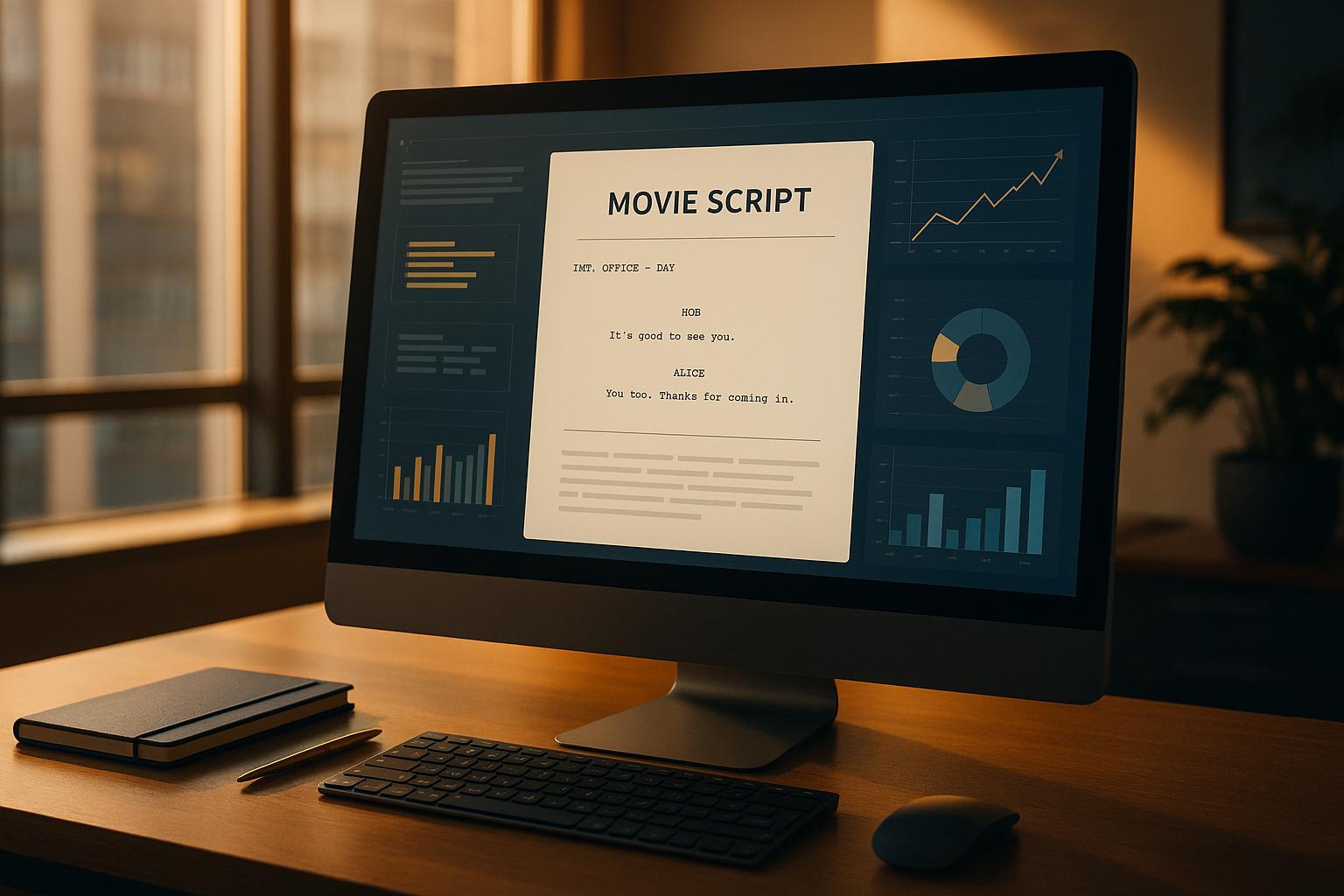
- "Artificial AND Intelligent - Largo.ai: Predict the potential box office by using AI" Masterclass
- What AI Evaluates in Scripts
- The AI Process: From Script to Prediction
- Pros and Cons of AI Predictions
- How Filmmakers and Studios Use AI Insights
- The Future of AI in Script Analysis
- FAQs
AI is transforming how the film industry evaluates scripts and predicts box office outcomes. By analyzing elements like plot, characters, and market trends, AI tools provide data-driven insights that help studios refine scripts, allocate budgets, and reduce risks. Key benefits include faster evaluations (minutes instead of days), improved ROI, and higher accuracy in identifying potential hits. However, AI struggles with unconventional stories and relies heavily on historical data, which can limit its ability to predict success for unique projects. Studios are using AI not as a replacement for human judgment but as a tool to complement decision-making, balancing creativity with business strategy.
"Artificial AND Intelligent - Largo.ai: Predict the potential box office by using AI" Masterclass
What AI Evaluates in Scripts
AI evaluates scripts by breaking them into measurable components and comparing them with historical film data to predict box office performance. This process focuses on three main areas: storytelling elements, commercial potential, and historical comparisons.
Story and Character Elements
AI dives deep into storytelling, analyzing plot structure and narrative flow to ensure stories are engaging and logically sound. It also examines character development, looking for meaningful transformations in protagonists and consistent behaviors that align with established traits. Advanced systems even score characters based on specific traits - like being anxious, heroic, greedy, or altruistic - and evaluate how these traits influence the story.
Dialogue is another key focus. AI assesses whether the dialogue feels natural, moves the story forward, and connects emotionally with the audience.
The impact of these evaluations is evident in real-world results. For instance, Warner Bros. reported a 25% improvement in selecting successful scripts and a 20% decrease in financial losses from underperforming films after incorporating AI into their decision-making process over two years.
Market Appeal Factors
AI doesn't just analyze storytelling - it also evaluates a script's commercial potential. By examining how well a script fits within its genre and aligns with current audience preferences, AI identifies target demographics and highlights market trends. It can even spot opportunities in underserved segments.
These tools also estimate return on investment by combining box office projections with budget data. By comparing scripts to similar successful films in terms of genre, tone, and themes, AI provides actionable insights for strategic planning. For example, Warner Bros. used AI to optimize the marketing campaign for Aquaman in March 2024, which played a role in its box office success.
Historical Data Comparison
AI's ability to benchmark scripts against historical data is one of its strongest advantages. These systems maintain extensive databases of past films, including box office results, audience demographics, and critical responses. When evaluating a new script, AI identifies films with similar themes, genres, and tones, then analyzes their performance to forecast potential outcomes.
This approach has proven effective. In a study of 62 films from 2014–15, AI successfully flagged 22 out of 32 loss-making projects while greenlighting all the top-performing films at the U.S. box office. Some advanced models have even achieved up to 99% accuracy in predicting box office performance by analyzing factors like cast strength, budget efficiency, release timing, and social media buzz.
The origins of these tools highlight their value. The 2003 film Gigli earned just $7.2 million against a $76 million budget. Nadira Azermai, an intern at the time, believed such a loss could have been avoided with rigorous script evaluation, inspiring the development of predictive analysis tools.
Still, industry experts stress that AI is a complement, not a replacement, for human judgment. As filmmaker Ava DuVernay puts it:
"AI is a powerful lens, but human insight is the light that brings a story into focus."
Platforms like AIScriptReader make these advanced tools accessible to both independent filmmakers and major studios, offering detailed coverage reports and development notes. By combining AI-driven insights with human creativity, these tools help filmmakers make informed decisions, ultimately improving the odds of box office success.
The AI Process: From Script to Prediction
Transforming a script into a box office prediction is a fascinating journey where creative storytelling meets data-driven insights. Today’s AI platforms make this process surprisingly efficient, turning what used to take weeks into a matter of minutes. From uploading a script to generating financial forecasts, the process ensures a thorough evaluation of both creative and commercial potential.
Script Upload and Processing
The process kicks off with the script upload, as seen with platforms like AIScriptReader. Once uploaded, the AI ensures confidentiality and safeguards intellectual property while diving into the analysis.
Using advanced natural language processing (NLP) algorithms, the system breaks down the script to analyze its narrative structure, character arcs, and emotional tone. It evaluates character development and emotional impact, comparing these elements against an extensive database of films. Incredibly, some AI tools can complete this entire analysis in just six minutes, processing scripts against more than 200 historical parameters.
This detailed review doesn’t stop at storytelling. It also examines dialogue, screen time, and even flags potential legal or safety concerns that could complicate production.
Report Creation and Analysis
Once the processing is complete, the AI generates comprehensive reports that provide valuable insights. These reports generally come in two forms: Coverage Reports and Development Notes. Coverage Reports summarize a script’s strengths, weaknesses, and market potential, while Development Notes offer in-depth, actionable feedback for improvement.
The analysis digs deeper than surface-level observations. For example, the AI can identify copyright risks or safety issues within specific scenes. This thorough approach not only helps filmmakers refine their creative vision but also aids in planning production logistics.
One of the biggest advantages is speed. AI tools can reduce the time it takes to analyze a script from several days to just minutes, offering a turnaround that’s more than 20 times faster than traditional human analysis. This efficiency means studios and filmmakers can review more scripts and make decisions faster, without compromising on quality.
Box Office Prediction Results
The final and perhaps most impactful step is the box office prediction. AI systems synthesize all the analyzed elements - story structure, character development, market appeal, and historical comparisons - to forecast a script’s commercial viability.
These forecasts have demonstrated impressive accuracy. In one study, AI achieved up to 87% accuracy in predicting a film’s financial performance. For example, an analysis of 62 films from 2014–15 showed that AI correctly flagged 22 out of 32 loss-making projects and approved all 30 films that went on to succeed at the U.S. box office.
The results speak for themselves. Warner Bros., for instance, saw a 25% improvement in selecting successful scripts and a 20% drop in box office flops after adopting AI-assisted analysis. In one case, an AI-identified mid-budget film delivered a 30% higher return on investment than traditional methods had predicted.
These predictions don’t just stop at revenue forecasts - they also include insights into target demographics, risk assessments, and budget-based ROI projections. By merging these financial forecasts with production data, studios can make smarter, more informed decisions about where to allocate resources.
This approach takes script evaluation from being a subjective art to an objective science, empowering filmmakers to make decisions that balance creativity with business strategy.
sbb-itb-44d62f7
Pros and Cons of AI Predictions
Understanding what AI can and can't do is essential for filmmakers and studios looking to integrate this technology into their creative workflows. Let’s dive into both sides of the equation.
Benefits of AI Script Analysis
AI brings speed and objectivity to script evaluations, making it possible for studios to analyze hundreds of scripts in just minutes. This removes human bias and industry politics from the initial review process, leveling the playing field for creative ideas.
The financial benefits are hard to ignore. Some predictive box-office tools claim up to 96.3% accuracy in forecasting commercial success for 2023. Such precision allows studios to make smarter investment decisions, significantly reducing financial risk.
Traditionally, script coverage involves days or even weeks of work, requiring multiple readers and lengthy discussions. AI flips the script, completing this process in minutes. This efficiency benefits even smaller production companies, giving them access to tools that were once exclusive to major studios.
"AI takes the guesswork out of filmmaking, allowing studios to focus on what they do best: telling stories. By providing actionable insights, AI helps studios make better decisions at every stage of the process." - Jig Reel Studios
Another standout feature is AI’s ability to detect patterns that might escape the human eye. By analyzing thousands of films, AI can uncover subtle connections between script elements and box-office performance. These insights help studios better understand audience preferences and predict market trends.
With these advantages, it’s clear how AI can be a game-changer. But what about the challenges?
Limitations and Challenges
AI, for all its strengths, struggles when it comes to creativity. It tends to favor familiar patterns, which means unconventional or groundbreaking films often get undervalued. Because AI learns from historical data, it has a hard time recognizing the potential of stories that break traditional molds.
"The biggest problem in the movies is too many formulas. There is a lack of originality, and that's why the industry isn't performing... Entertainment relies on new ideas, and this technology can't produce them." - Jonathan Taplin, director emeritus at the Annenberg Innovation Lab at USC
Another issue is the quality of the data AI relies on. Poor or biased historical data can skew predictions, potentially reinforcing existing inequalities or ignoring shifts in audience preferences.
AI also falls short in accounting for unpredictable factors like global events or cultural changes that can dramatically influence a film’s success.
When it comes to creative development, AI shows its limitations. While it excels at analyzing data, it can’t provide the nuanced feedback writers need to refine their scripts.
"It outputs only average content... It's nowhere near capable of the symbolic abstraction necessary for script development, and it can't output a script with narrative structure and character arcs." - Yves Bergquist, director of the AI & Neuroscience in Media Project at USC's Entertainment Technology Center
There are also ethical concerns. Using personal data for audience predictions raises questions about consent and potential misuse. Over-relying on AI could lead to a homogenized industry, where only formulaic projects get the green light.
Pros vs Cons Comparison Table
Here’s a side-by-side look at the advantages and challenges:
| Advantages | Limitations |
|---|---|
| Speed: Minutes vs. days for analysis | Creative blind spots: Struggles with unconventional films |
| Objectivity: Eliminates human bias | Data dependency: Relies on quality of historical data |
| High accuracy: Up to 96.3% prediction rate | External factors: Can’t account for global events or cultural shifts |
| Cost efficiency: Reduces need for human labor | Limited feedback: Lacks nuanced input for script improvements |
| Pattern recognition: Detects correlations humans might miss | Homogenization risk: Favors formulaic content over originality |
| Scalability: Handles hundreds of scripts at once | Privacy concerns: Raises ethical questions about data use |
The key takeaway? AI is a tool, not a replacement. As one expert put it, "The role of AI in predicting film performance is undeniably transformative, offering valuable insights that can inform decision-making for both investors and producers. However, it's crucial to remember that filmmaking is both an art and a science".
Smart filmmakers and studios know how to strike a balance. By leveraging AI to complement human creativity, they can make better decisions while keeping the artistic heart of filmmaking intact. We’ll explore how this balance enhances creative decision-making in the next section.
How Filmmakers and Studios Use AI Insights
Now that we’ve explored the possibilities and limitations of AI predictions, let’s dive into how filmmakers and studios are applying these insights. From fine-tuning scripts to smarter budgeting and marketing, AI is becoming a vital part of the filmmaking process.
Refining Scripts with AI Feedback
One of the first places AI is making waves is in script development. Tools like AIScriptReader help polish screenplays by identifying narrative weaknesses, continuity errors, and underdeveloped character arcs. For instance, in February 2025, an independent filmmaker used AIScriptReader to refine their script before submitting it to film festivals. The result? Increased interest from festivals and successful distribution deals. AI doesn’t just point out flaws - it also highlights key themes and suggests alternative plotlines, sparking ideas that writers might not have considered. This kind of feedback not only elevates creative storytelling but also sets the stage for smarter decisions around budget and marketing.
Smarter Budgeting and Marketing Strategies
AI is also reshaping how studios handle budgets and marketing campaigns. By analyzing massive datasets, AI tools can predict the best cast combinations, estimate audience reception, and even gauge a project’s commercial potential. In February 2025, AIScriptReader helped a small production company cut their script review time by 75%. At the same time, a major studio used the tool to evaluate 50% more projects, making resource allocation far more efficient. Studios are also using AI to define clear goals and test pilot projects. For example, Netflix leverages AI to analyze viewer behavior, which helps them create personalized recommendations.
Predicting Box Office Performance
Once scripts are refined and plans are in place, AI steps in to forecast box office outcomes. By combining narrative analysis with historical data, tools like AIScriptReader provide studios with market projections to validate creative decisions. A great example of this comes from 2019, when Largo Films used AI to analyze the script for the Italian film Domani è Un Altro Giorno. The tool predicted a box office range of €1.6M to €4M, and the film ultimately grossed €1.6M - right in line with the forecast, even during a challenging 18% market slowdown in Italy. Interestingly, the analysis suggested that a narrative tweak could have boosted revenue by 14%. Beyond box office predictions, AI also assesses audience sentiment and demographic trends, helping studios craft targeted marketing strategies. These tools are leveling the playing field, giving both indie creators and major studios access to advanced analytics.
The Future of AI in Script Analysis
AI is reshaping the film industry, influencing everything from initial story concepts to final market delivery. As we've explored, its role goes far beyond simple automation - it's actively transforming how creative choices are made and validated.
Currently, over 64% of media companies are incorporating AI into their operations. The market for AI in film is expected to grow significantly, not just for improving efficiency but as a survival tool in an environment where only 36% of U.S. films manage to exceed their production budgets.
Looking ahead, several trends are starting to take shape. Advanced AI models are being developed to analyze real-time social media trends and create highly detailed audience segmentations, helping refine box office predictions. Real-time audience feedback systems are also emerging, enabling filmmakers to make adjustments during test screenings before a movie's official release. The ultimate goal? AI tools that can support every stage of film production - from scriptwriting to post-production.
The potential is already evident. In early 2024, The Frost demonstrated how advanced natural language processing and image-generation algorithms could craft an entire narrative, from the script to the visuals, with only minimal human input. Established studios are also embracing AI. Warner Bros., for instance, partnered with Cinelytic in 2022 for AI-assisted decision-making, while Netflix relies heavily on AI tools to guide its content strategy. These developments highlight how filmmakers can use AI to gain a competitive edge.
Main Takeaways
AI script analysis offers more than just speed - it brings precision and objectivity to the table. It can evaluate thousands of scripts in mere minutes, eliminating the biases that often cloud human judgment. Instead of relying on subjective preferences, AI delivers insights rooted in historical data and performance trends. For example, companies integrating AI into their marketing strategies have seen a 10–20% increase in sales ROI, and AI-powered workflows can improve media delivery efficiency by up to 40%.
Rather than replacing human creativity, AI is complementing it. By taking over analytical tasks, it frees up filmmakers to focus on the creative aspects, while providing data-driven insights to guide their decisions.
Next Steps for Filmmakers
To fully capitalize on these advancements, filmmakers should begin integrating AI tools into their workflows. Tools like AIScriptReader streamline script development while offering valuable market insights to inform both creative and business strategies.
Experimentation is crucial. Nearly 70% of AI-focused studios operate with teams of five or fewer, giving independent filmmakers the opportunity to achieve high production values without massive budgets. For instance, Secret Level reports that a $10 million budget can deliver production quality comparable to a $30 million project when AI-enhanced pipelines are used. This levels the playing field, allowing indie creators to compete with major studios in terms of visual quality and production value.
A hybrid approach - combining AI's efficiency with human creativity - is key to success. As Netflix's Ted Sarandos puts it:
"The future of AI in cinema isn't about cutting corners - it's about enhancing quality by '10%'".
This mindset should guide how AI is adopted: using it to add meaningful value without compromising artistic vision.
Finally, ethical and privacy considerations must remain a priority. Filmmakers should ensure that AI tools are used responsibly, particularly when handling personal data or using actors' voices and likenesses for training and replication. Transparency and consent are essential to maintaining trust and meeting industry standards.
The entertainment industry is on the brink of a new era, where collaboration between humans and AI will be the key to success. Filmmakers who embrace this partnership - leveraging AI for analysis, efficiency, and optimization while preserving the creative core - will be best positioned to thrive in this rapidly evolving landscape.
FAQs
How does AI combine creativity and data-driven analysis to evaluate scripts?
AI blends imaginative storytelling with data-driven precision, employing advanced algorithms to spot patterns and trends in successful scripts while honoring the uniqueness of each narrative. It examines key aspects like character arcs, plot progression, and dialogue, all without overshadowing the writer's creative voice.
By drawing from extensive datasets, AI helps ensure scripts resonate with audience preferences and meet market expectations. This approach empowers filmmakers to craft stories that are both engaging and commercially appealing.
What challenges does AI face in predicting box office success for unique or unconventional films?
AI often faces challenges when trying to predict the box office success of films that are unconventional or break away from the norm. A big part of this comes down to how these systems are built - they rely heavily on historical data. That means they might miss the mark when it comes to recognizing the appeal of unique storytelling or niche creative elements that don’t fit into established patterns.
Another hurdle is that AI tools can sometimes favor reinforcing trends that have worked in the past. This makes it harder for them to evaluate projects designed to challenge or redefine those norms. For instance, while script analysis platforms can be incredibly useful for spotting strengths and weaknesses in a screenplay, they may fall short in assessing the untapped creative potential of experimental or avant-garde films.
How can filmmakers ensure AI tools are used ethically, especially regarding data privacy and consent?
Filmmakers can promote responsible use of AI tools by adhering to strict data privacy laws, clearly disclosing how data is collected and used, and securing informed consent from individuals whose data is involved. Regularly conducting audits and bias evaluations is equally important to uphold fairness and accountability.
Moreover, designing AI systems with built-in privacy protections and transparent, explainable processes can help maintain trust while respecting user rights. These steps lay the groundwork for using AI responsibly in the film industry.
Free Screenwriting Tools
Tools to use alongside your writing — no signup, no cost.
Free Screenplay Editor
Write and auto-format scripts in your browser. Cloud autosave, PDF & Fountain export.
Open tool →AI Script Breakdown
Upload a script and every scene is tagged with its production elements. $29 per script.
Open tool →Get a Full Coverage Report — $39
AI screenplay coverage and development notes in minutes. No subscription.