How AI Scores Scripts for Global Markets

- Largo.ai Script Analysis and Success Forecasting
- Core Metrics Used in AI Script Scoring
- How AI Analyzes and Scores Scripts
- Evaluating Scripts for International Appeal
- Benefits of AI-Powered Script Evaluation
- Conclusion: Using AI for Global Film Success
- FAQs
AI is reshaping the way scripts are evaluated, offering faster, data-driven insights that help filmmakers improve their work for global audiences. Tools like AIScriptReader analyze key elements such as plot, characters, pacing, dialogue, and themes to assess a script's marketability. For as little as $39, writers and studios can receive detailed reports, saving time and reducing costs in the production process. Here's what you need to know:
- What AI Does: Breaks down scripts, analyzes themes, suggests improvements, and predicts audience reactions.
- Why It Matters: Global success hinges on appealing to diverse audiences. AI compares scripts to international hits and identifies universal elements.
- Key Metrics: Plot structure, character development, pacing, dialogue, and thematic consistency.
- Real Benefits: Studios report a 25% boost in script selection accuracy, 35% fewer revisions, and 30% lower development costs.
AI tools like AIScriptReader streamline script analysis, offering quick, objective feedback while maintaining confidentiality. Writers retain creative control but gain valuable insights to refine their work for international success.
Largo.ai Script Analysis and Success Forecasting

Core Metrics Used in AI Script Scoring
AI-driven script analysis employs a detailed framework to evaluate a screenplay's potential for global success. These metrics work together to provide a thorough assessment of a script's strengths and areas for improvement.
Key Evaluation Criteria
Scripts are assessed across five major dimensions that contribute to their global appeal:
- Plot Structure: AI evaluates the script's three-act progression, pacing, and key tension points. It checks whether the story follows a rhythm and structure that resonates with international audiences.
- Character Development: The system analyzes character arcs, dialogue authenticity, and emotional depth to ensure the characters feel relatable and engaging across different cultures.
- Pacing Analysis: By reviewing the flow of the story, AI tools identify scenes that might be too slow or too rushed. These are compared against industry benchmarks to ensure a balanced narrative rhythm.
- Dialogue Quality: AI examines dialogue for its natural tone, sensitivity to cultural nuances, and ease of translation, ensuring it remains authentic and adaptable for diverse audiences.
- Thematic Consistency: The system ensures the story maintains clear and cohesive messaging throughout, making sure the central themes are evident and impactful.
These criteria collectively form the foundation for calculating a script's marketability.
Measuring Marketability
AI tools generate marketability scores by aligning the script's elements with established global trends. This includes assessing genre compatibility to determine whether the script features components that perform well in international markets. Additionally, a market relevance check evaluates the screenplay’s subject matter against recent box office successes to gauge its alignment with current trends.
For instance, AIScriptReader uses these metrics to deliver precise marketability scores. Studios leveraging such AI tools have reported significant benefits, including a 25% increase in script selection accuracy, a 35% reduction in the number of revision cycles, and a 30% decrease in development costs. While traditional script evaluations can take up to 10 days, AI-powered systems can complete an initial analysis in just two hours. This efficiency allows studios to review more projects and make quicker decisions on development.
Comparing Scripts to Successful Films
AI systems also maintain extensive databases of successful international films, enabling them to compare new scripts against proven hits. By analyzing narrative structures, character archetypes, and thematic elements, these tools can identify scripts with strong commercial potential. They also highlight potential challenges in competitive markets.
For example, Paradigm Talent Agency adopted AI-powered script analysis to dramatically cut their script coverage time by over 95%. What once took days now takes minutes, allowing their team to handle 30% more scripts each week without expanding staff.
This comparative analysis not only helps studios identify promising scripts but also provides writers with valuable insights. By understanding how their work aligns with current industry trends, writers can refine their creative vision to better match market demands.
How AI Analyzes and Scores Scripts
AI-powered script analysis is transforming how screenplays are evaluated, offering filmmakers a faster and more structured way to refine their work. By understanding how these systems function, filmmakers can make smarter decisions and unlock their script's potential on a global scale.
AIScriptReader's 3-Step Workflow
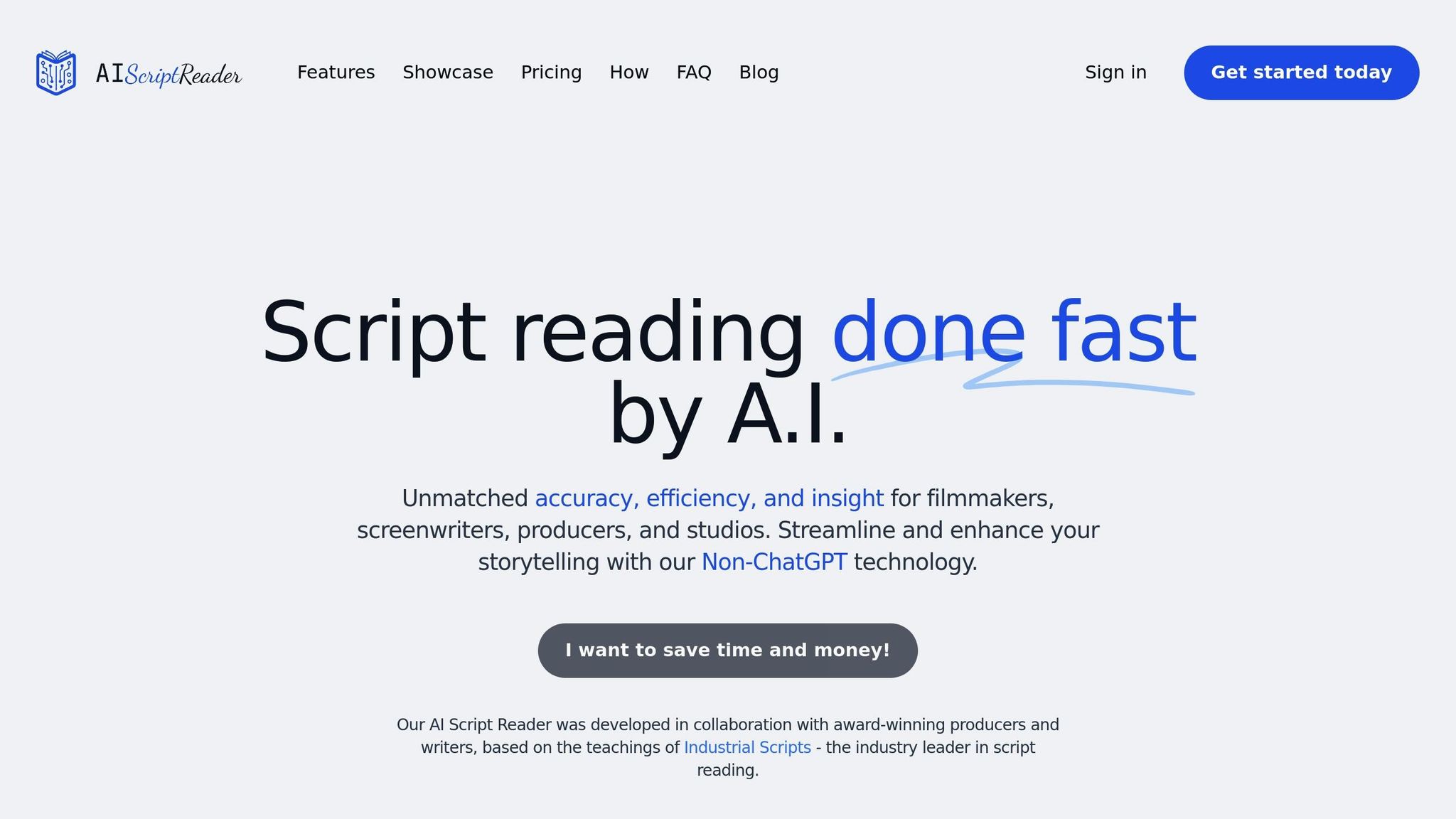
AIScriptReader has simplified the traditionally complex process of script analysis into three easy steps, making it accessible and efficient for writers and producers alike.
- Step one: Upload your script to a secure dashboard. The platform accepts standard screenplay formats and guarantees confidentiality.
- Step two: Let the AI do the heavy lifting. It evaluates plot structure, character arcs, dialogue, and thematic elements. What used to take weeks is now completed in just hours.
- Step three: Receive a detailed report highlighting the script’s strengths, weaknesses, and market potential. This allows filmmakers to make quick, informed revisions without unnecessary delays.
Users have responded positively to this streamlined process, with the platform earning an overall rating of 4.4 out of 5 based on 12 reviews. Customer support is particularly praised, scoring 4.8 for responsiveness and assistance.
Objective, Data-Driven Feedback
One of the biggest drawbacks of traditional script evaluations is subjectivity. AIScriptReader eliminates this issue by using advanced algorithms to deliver objective, data-driven insights. By analyzing narrative structures, character development, and dialogue patterns, the system provides consistent and unbiased feedback. This ensures that filmmakers can rely on its evaluations to make confident decisions about their projects.
Coverage Reports vs. Development Notes
To cater to different stages of the scriptwriting process, AIScriptReader offers two types of feedback:
- Coverage Reports: These provide a concise overview of the script’s strengths, weaknesses, and marketability. Perfect for a high-level evaluation.
- Development Notes: For those looking to dive deeper, these notes offer actionable suggestions for improving pacing, character development, dialogue, and structural elements.
The platform’s value has been widely recognized, with users rating "Good Value" at 4.4 and "Price & Quality" at 4.5 stars. Its user-friendly dashboard also makes it easy to manage multiple projects, further solidifying AI-driven script analysis as a go-to tool for filmmakers aiming to succeed in competitive global markets.
sbb-itb-44d62f7
Evaluating Scripts for International Appeal
When aiming for global audiences, understanding how a script resonates across different cultures is crucial. Building on earlier evaluation metrics, it’s essential to identify storytelling elements that universally captivate. AI tools are particularly effective in this area, analyzing narrative patterns, cultural sensitivities, and themes that connect with audiences worldwide. This process helps pinpoint universal ideas that transcend borders.
Cross-Border Appeal and Language Considerations
AI plays a pivotal role in assessing scripts for potential biases or stereotypes by analyzing dialogue, cultural references, and narrative elements. This insight allows filmmakers to refine their scripts, ensuring they are better suited for international markets.
Language also plays a significant role in global appeal. Scripts packed with region-specific slang or idioms may struggle to connect with broader audiences. AI evaluates dialogue complexity and idiomatic expressions, scoring scripts based on how easily they can be adapted for diverse markets. More universal communication styles tend to receive higher ratings. Additionally, AI reviews character interactions and social dynamics to ensure they align with a variety of cultural values.
Finding Universal Themes
AI excels at identifying recurring themes and motifs, mapping out a script’s core messages to assess its global appeal. This thematic analysis serves two purposes: it ensures a screenplay’s messaging remains consistent and uncovers any unintended themes that might emerge.
By comparing a script’s themes to those of successful international films, AI provides valuable feedback on whether the story aligns with genre expectations and resonates across cultures. Universal themes like family bonds, personal growth, justice, and love tend to perform well internationally, as they speak to shared human experiences. Scripts with these elements often score higher for global marketability than those that rely heavily on localized narratives.
This analysis helps writers refine their thematic focus, ensuring their stories have a broad, cross-cultural reach. AI makes these underlying ideas clear, guiding storytellers to align their core messages with a global audience.
Addressing Localization Challenges
Adapting scripts for specific regions comes with its own set of challenges, and AI is a powerful tool for anticipating these hurdles. It evaluates how well content aligns with regional norms and communication styles, helping filmmakers make necessary adjustments. AI can even flag potential legal issues, such as copyright concerns, that might arise when tailoring a script for different markets. This proactive approach can save both time and money during production.
Ketty Tirrito, Localization Manager at Zendesk, explains, "AI speeds up processes and resolves long-standing backlog tasks, though it still requires human oversight".
For instance, during the analysis of a Langston Hughes adaptation, AI was able to adjust culturally sensitive references while preserving the story’s core themes about social discrimination. This demonstrates how AI can streamline localization while maintaining the integrity of the narrative.
However, human oversight remains essential. Pairing AI’s efficiency with the expertise of native linguists and cultural consultants ensures scripts resonate authentically with their target audiences. By addressing these challenges early in the process, filmmakers can fine-tune their scripts for greater international success. This hybrid approach leverages AI’s analytical power while preserving the cultural nuance that makes stories connect on a deeper level across the globe.
Benefits of AI-Powered Script Evaluation
AI-powered script evaluation offers more than just automation - it’s transforming the way filmmakers, producers, and studios approach script analysis. In an industry where time, quality, and cost are critical, these tools provide solutions that traditional methods struggle to match. Let’s break down how AI saves time, improves quality, and ensures your creative work is handled securely.
Time and Cost Savings
One of the standout advantages of AI in script evaluation is how quickly and affordably it works. While traditional script coverage might take up to 10 days, AI tools can deliver detailed assessments in just two hours. That’s a 20x improvement in turnaround time.
And the cost? Tools like AIScriptReader provide in-depth analysis for just $39 per script - a fraction of what traditional services charge. Plus, the impact goes beyond speed and price. Warner Bros. found that using AI for script selection reduced box office flops by 20%. As Matisse Tolin, a seasoned writer and film festival founder, remarked:
"In my fifteen years of writing and reading coverage, I have never seen such helpful analysis turned over with such speed."
– Matisse Tolin
AI doesn’t just save time and money; it also flags issues like plot holes, timeline inconsistencies, and weak character arcs early in the process. By addressing these problems upfront, studios avoid costly fixes during production, positioning projects for smoother development and better outcomes.
Better Script Quality and Market Positioning
AI tools go beyond simple analysis - they dive deep into story structure, pacing, character development, and thematic elements, offering insights that would typically require multiple human readers. Writers get clear, actionable feedback, helping them understand not only what needs improvement but why certain elements may not be resonating.
AI also excels at aligning scripts with market demands. By comparing a script's components to successful films in similar genres, it identifies ways to enhance marketability without compromising creativity. For example, one AI-identified script went on to generate a 30% higher ROI than initially forecasted.
This precision reduces the need for endless revision cycles, allowing teams to focus their efforts where it matters most. Smaller studios, in particular, benefit by gaining the ability to evaluate a higher volume of scripts at speeds previously attainable only by major players.
Secure and Confidential Script Handling
In an industry where intellectual property is everything, keeping scripts secure is non-negotiable. AIScriptReader ensures that your work stays protected throughout the evaluation process.
"Yes, your script is secure and confidential when using AIScriptReader, as we ensure it is securely stored and protected."
Unlike traditional coverage services, which often involve multiple human readers, AI operates within a controlled, secure environment. This is especially important for high-profile projects or early-stage scripts. For independent filmmakers and smaller production companies, this level of security offers peace of mind while providing access to professional-grade evaluation - something that once required costly industry connections.
Conclusion: Using AI for Global Film Success
The entertainment industry's global AI market is predicted to skyrocket, growing from $17.1 billion in 2023 to an impressive $195.7 billion by 2033. For filmmakers aiming to thrive internationally, AI-powered script analysis is no longer optional - it's a game-changer.
Key Takeaways
AI is revolutionizing how scripts are evaluated for global success. By providing data-driven insights, it helps filmmakers assess a script’s marketability across international audiences. Studios leveraging AI report a 25% increase in script selection accuracy, 35% fewer revision cycles, and a 30% cut in development costs. These gains translate directly into a competitive edge.
One of AI’s standout advantages is its ability to significantly speed up the evaluation process. This allows filmmakers to iterate faster, refine their creative vision, and act quickly to capture market opportunities. It also excels at uncovering universal themes and tackling localization challenges - key factors in creating films that resonate across diverse cultures and languages. By analyzing successful films from different regions, AI gives writers the tools to craft stories that balance creative depth with global appeal.
Another critical benefit is AI’s ability to eliminate human bias. By relying on consistent, data-backed evaluations based on industry benchmarks, it ensures fair and objective decision-making. Whether deciding to greenlight a project, allocate budgets, or plan marketing strategies, these insights are invaluable.
Next Steps for Filmmakers
To harness these benefits, filmmakers should integrate AI as a strategic partner in their creative workflow. Tools like AIScriptReader offer an easy way to get started. For as little as $39, you can receive a detailed coverage report, or for $69, you can add development notes to refine your script even further. These tools provide a cost-effective way to improve script quality and position your work for global success - while ensuring your creative content is handled securely.
Use AI to pinpoint themes that resonate universally and simplify the revision process. By doing so, you’ll gain actionable insights that help control development costs and enhance your script’s global appeal.
The future of filmmaking belongs to those who blend artistic vision with data-driven strategies. AI doesn’t replace creativity; it amplifies it by delivering the insights needed to craft stories that break international barriers. Your next big hit could be just a script away - with AI as your secret weapon for global success.
FAQs
How does AI keep scripts secure and confidential during analysis?
AI takes script security and confidentiality seriously by implementing strong protections like encryption, access controls, and real-time threat monitoring. These measures work together to keep scripts safe from unauthorized access.
On top of that, privacy-focused methods such as data masking and anonymization are used to safeguard sensitive information during the evaluation process. This way, your creative work remains secure and private at every stage.
What challenges might filmmakers encounter when using AI to evaluate scripts for diverse cultural markets?
Filmmakers often encounter hurdles when working with AI, particularly due to its limited grasp of cultural nuances. AI may struggle to accurately interpret local traditions, humor, or storytelling styles, which can result in scripts that don't resonate with specific audiences as intended.
Another challenge lies in AI's inability to consistently identify cultural taboos or sensitive topics. This can sometimes lead to unintentional missteps, such as misrepresentation or causing offense. While AI can provide helpful insights, blending its capabilities with human expertise is crucial to crafting scripts that genuinely connect with diverse cultural markets.
How can filmmakers use AI insights without compromising their creative vision?
Filmmakers can think of AI as a helpful assistant that complements their creativity, not something that takes it over. It can analyze data trends and audience preferences to offer suggestions about a script's potential appeal. But at the end of the day, the filmmaker's artistic vision should always take center stage.
When filmmakers use AI feedback as a resource instead of a rulebook, they can fine-tune their scripts while keeping their storytelling intact. This approach helps ensure that the final story feels genuine and connects with audiences in a meaningful way.
Free Screenwriting Tools
Tools to use alongside your writing — no signup, no cost.
Free Screenplay Editor
Write and auto-format scripts in your browser. Cloud autosave, PDF & Fountain export.
Open tool →AI Script Breakdown
Upload a script and every scene is tagged with its production elements. $29 per script.
Open tool →Get a Full Coverage Report — $39
AI screenplay coverage and development notes in minutes. No subscription.