Original Scripts vs. IP Adaptations: What Studios Want
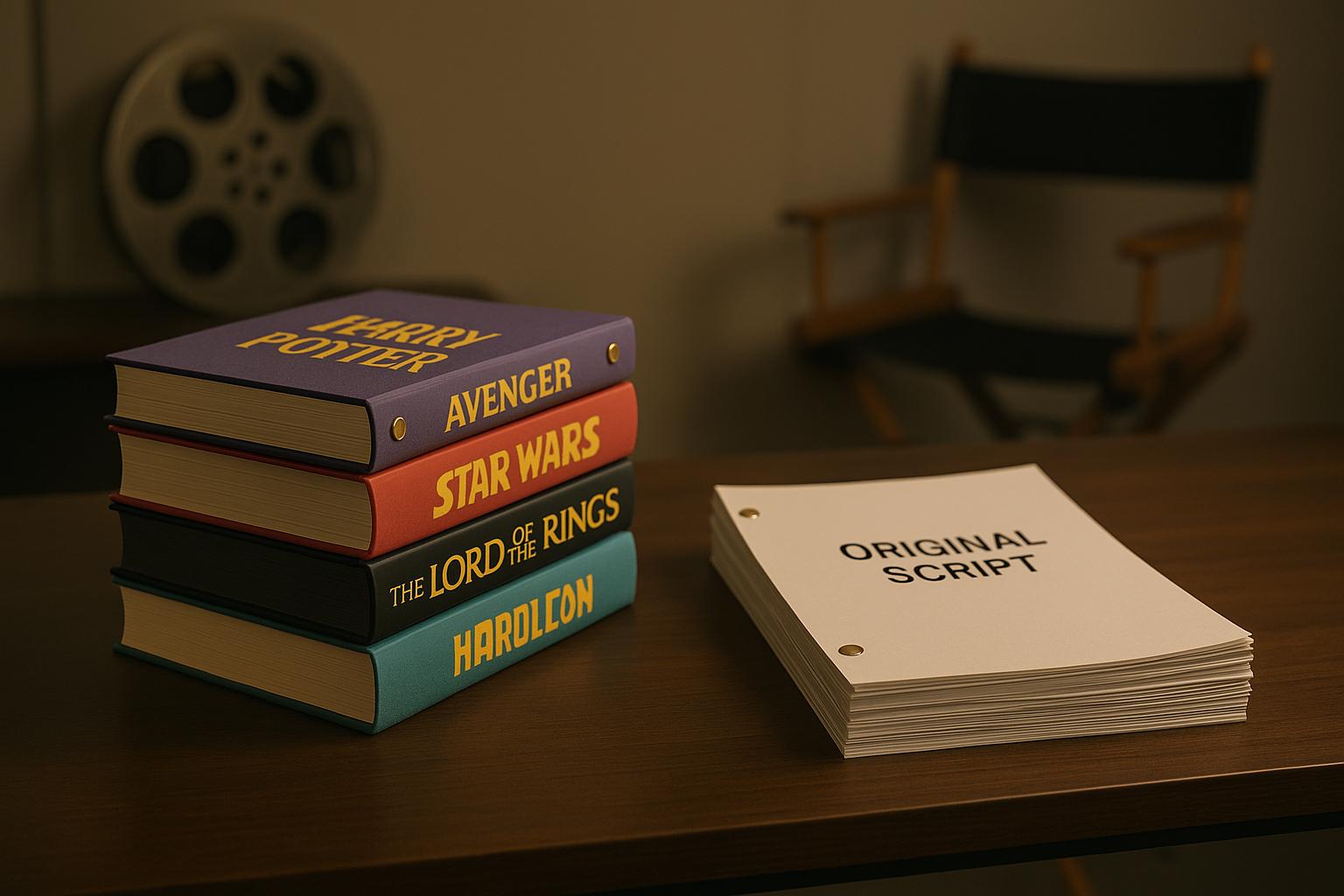
- Why Do We Keep Adapting The Same Stories?
- Defining Original Scripts and IP Adaptations
- What Studios Want: Script Acquisition Priorities
- Original Scripts vs IP Adaptations: Direct Comparison
- How AI Changes Script Evaluation
- Conclusion: Balancing Both Approaches
- FAQs
- Why Streaming Platforms Are Betting Big on Original Scripts in 2025
Studios in 2025 are balancing original scripts and IP adaptations to manage creative risks and financial returns. While IP-based films dominate box office revenues, original content remains crucial for streaming platforms and global storytelling. Here's what you need to know:
- IP Adaptations: Safer bets with built-in audiences, lower marketing costs, and proven success. They make up 71% of top domestic films grossing over $100M.
- Original Scripts: Offer new ideas but are harder to market. Streaming platforms and international markets drive demand for diverse, lower-cost productions.
- Market Trends: Between 2020–2024, only 12% of new releases were IP-based, yet these dominated viewership stats. Studios are focusing on fewer, high-impact projects.
- AI's Role: Tools like AIScriptReader accelerate script evaluation, cutting costs and improving decision-making.
Studios are navigating a tightrope: leveraging popular franchises while seeking fresh stories that resonate globally. Writers and producers must align with these shifting priorities to succeed.
Why Do We Keep Adapting The Same Stories?
Defining Original Scripts and IP Adaptations
Understanding the difference between original scripts and IP adaptations sheds light on how studios make acquisition decisions. Each approach plays a unique role in the entertainment industry, presenting specific opportunities and challenges for writers, producers, and studios.
Original Scripts: Fresh Ideas and Stories
Original scripts are built entirely from scratch. Writers working on these projects have the freedom to create new characters, plots, and worlds tailored specifically for the screen.
This creative independence allows writers to explore any theme without being tied to pre-existing material or the expectations of an existing fanbase. However, the lack of an established audience can make these scripts harder to market. Even so, original scripts often act as a writer's calling card, showcasing their ability to build engaging stories from the ground up. This can lead to future opportunities with studios, even if the original script doesn't get produced.
IP Adaptations: Transforming Existing Stories
IP adaptations take existing works - like books, comics, video games, or TV shows - and reimagine them for film or television. These projects come with clear advantages for studios, including built-in audience recognition and proof of prior success.
For writers, adapting an IP involves striking a balance between creative interpretation and staying true to the source material. The process often includes multiple revisions to fit production needs. Writers must trim unnecessary details, craft dialogue that works on screen, and ensure the story translates visually while remaining faithful to its core essence.
Studios evaluate potential IPs based on several factors, including the strength of the plot, the appeal of its characters, its fan following, audience potential, and the feasibility of securing legal rights. Acquiring these rights often involves complex negotiations with rights holders, requiring studios to present a clear plan for the adaptation.
The industry's reliance on IP adaptations has grown significantly. Back in 1981, only 16% of studio films were based on pre-existing IP, with original screenplays dominating the market. Today, the trend has flipped, with over 80% of films stemming from adaptations. Despite this, the creative process of transforming a story into a screenplay is considered an original contribution, underlining the unique effort involved.
Understanding these differences is crucial for navigating studio strategies and positioning your work effectively in the current market. Up next, we'll explore how these distinctions shape studios' priorities when acquiring scripts.
What Studios Want: Script Acquisition Priorities
Studios today are under immense pressure to deliver content that not only captivates audiences but also turns a profit - all while working within tighter budgets. In 2025, their acquisition strategies reflect a delicate balancing act between financial prudence and creative ambition, with clear trends emerging.
Why Studios Choose IP Adaptations
Familiarity equals security. Intellectual property (IP) adaptations come with a built-in audience and proven track records, making them a safer bet for studios. These projects offer measurable indicators of success, such as book sales or franchise popularity, which reduce the uncertainty of investing in original material. As Sarah Fain, a showrunner, aptly put it:
"IP is king right now. Adaptation muscles are essential."
This shift is evident in the way studios now heavily prioritize IP-based projects, a reversal from earlier trends favoring original scripts.
Marketing is easier (and cheaper). IP adaptations also come with the added bonus of established fan bases and existing promotional channels. This built-in appeal lowers marketing costs and reduces the risk of audience rejection. Studios are taking this a step further by packaging IP across multiple platforms - books, graphic novels, podcasts, and more - to reach broader audiences and maximize their investment.
Growing Interest in Original Scripts
Streaming platforms need fresh ideas. While IP adaptations dominate the big screen, streaming platforms thrive on original programming to stand out in a crowded market. This demand opens doors for original scripts, especially those that can be produced on tighter budgets compared to high-cost IP adaptations.
Original stories resonate globally. As studios expand into international markets, the need for diverse narratives has grown. Original scripts often tell stories that reflect a variety of cultures and perspectives, making them better suited for global audiences than reworked Western IP.
Lower costs make originals appealing. Securing IP rights often involves lengthy negotiations and hefty upfront fees. Original scripts sidestep these costs, allowing studios to allocate more resources to production or secure better profit margins. This cost-effectiveness is especially critical as studios scale back risky projects and focus on smarter spending.
New investors are backing original content. Private equity and hedge funds are increasingly funding niche and prestige projects, creating fresh opportunities for original scripts that might not align with traditional studio models.
These factors are driving studios to strike a balance between the reliability of IP adaptations and the creative possibilities of original content.
Managing Risk vs Creativity
Selective greenlighting is the new norm. Gone are the days of "blank check" deals. Studios now favor calculated investments, often opting for co-productions and licensing agreements to share financial risk with partners.
Money talks in creative decisions. Financial pressures from shareholders mean studios lean toward projects with more predictable returns over purely artistic ventures. To mitigate risk, they’re locking in talent early through exclusive first-look and overall deals. This approach secures financing pipelines for high-profile projects while prioritizing IP-driven content and genre-specific ventures over experimental ideas.
Studios are focusing their resources on fewer, bigger projects with the potential for significant impact. Experts predict that mergers and acquisitions may further reshape this approach, consolidating the industry’s focus even more.
Original Scripts vs IP Adaptations: Direct Comparison
Choosing between original scripts and IP adaptations isn't just about creative preference - it’s a strategic decision that influences every stage of a project, from development to commercial success. By understanding the trade-offs, writers can better position their work, and studios can weigh the risks and rewards. Let’s break it down with a detailed comparison.
Side-by-Side Comparison Chart
Historical trends reveal a significant shift in studio strategies, reflecting their efforts to balance risk while capitalizing on established market appeal.
| Factor | Original Scripts | IP Adaptations |
|---|---|---|
| Creative Freedom | Full control over story, characters, and world-building | Limited by source material and fan expectations |
| Financial Risk | Higher uncertainty due to lack of proven audience demand | Lower risk – 71% of top movies earning $100M+ domestically are from franchises |
| Development Costs | Lower upfront costs; no need for rights acquisition | Higher initial costs for licensing and rights negotiations |
| Marketing Advantage | Requires building awareness from scratch | Built-in recognition – 13 of 30 most-watched streaming titles in 2024 were IP-based |
| Audience Appeal | Must create emotional connection from the ground up | Leverages a pre-existing fanbase |
| Awards Potential | Often seen as more artistically ambitious | Typically perceived as more commercial |
| Global Reach | Relies on relatable themes and effective localization | Often benefits from established international popularity |
| Franchise Potential | Can create new intellectual properties and revenue streams | Already part of existing franchise ecosystems |
While IP-based content made up only 12% of new shows and movies released between 2020 and 2024, it has consistently outperformed original content commercially. This trend highlights studios' preference for safer, proven properties.
Original scripts face tougher challenges in today’s market. They must work harder to grab audience attention since every aspect of the story is unfamiliar. On the other hand, IP adaptations come with their own hurdles, like navigating rights agreements and managing fan expectations.
Streaming platforms have also reshaped this landscape. Take Netflix, for example: between 2015 and 2022, 33% of its original films were based on recycled content, and 66% of that was made up of adaptations. The share of recycled content on Netflix grew from 18% in 2016 to 39% in 2022, showing a clear shift toward using established intellectual properties.
Still, original scripts offer unique advantages. They allow for complete creative freedom and the chance to create sleeper hits that can grow into cultural phenomena. With the right marketing, an original screenplay today could become tomorrow’s valuable IP.
sbb-itb-44d62f7
How AI Changes Script Evaluation
The days of waiting weeks and spending thousands on traditional script coverage are being replaced by AI tools that deliver full script analysis in just two hours. This rapid turnaround is a game-changer for studios juggling original scripts and IP adaptations, all while relying on data-driven decisions. Here's a closer look at how AIScriptReader streamlines this process.
AIScriptReader's Script Analysis Process
AIScriptReader simplifies script evaluation through a three-step process that provides thorough analysis at a fraction of the cost. Writers and studios can upload their scripts, let the AI handle the heavy lifting, and receive detailed reports comparable to traditional coverage.
The platform offers two key services: Coverage Reports and Development Notes.
- Coverage Reports deliver concise evaluations of a script's strengths, weaknesses, and market potential. These reports include loglines, synopses, and in-depth assessments, helping decision-makers quickly judge a project's commercial viability - whether it's an original script or an IP adaptation.
- Development Notes go further by offering actionable suggestions for refining scripts. This service is especially helpful for original projects that need polishing to compete with established IPs. The AI also flags potential legal and safety issues, such as intellectual property conflicts or scenes requiring special precautions, like those involving minors.
At just $39 for a single Coverage Report or $69 for both Coverage and Development Notes, AIScriptReader offers an affordable way for independent writers and major studios to access professional-grade analysis. This efficient process supports studios in making faster, more informed decisions between original ideas and IP adaptations.
Why Studios Use AI Tools in 2025
AI script analysis tools have become essential for studios navigating a fast-paced industry. For example, Paradigm Talent Agency has slashed its coverage time by over 95%, allowing its team to review 30% more material each week.
The speed advantage is undeniable - AI tools can analyze scripts in two hours, compared to the 10 days traditional methods often require. This efficiency helps studios strike a balance between creative risk-taking and financial prudence.
AI also brings a level of objectivity that human reviewers can't always match. Studios using these tools report a 25% improvement in script selection accuracy, a 35% drop in revision cycles, and a 30% reduction in development costs.
Writer and film festival founder Matisse Tolin highlights the transformative impact of AI:
"In my fifteen years of writing and reading coverage, I have never seen such helpful analysis turned over with such speed".
However, industry leaders stress the importance of blending AI with human expertise. Acclaimed director Ava DuVernay puts it perfectly:
"AI is a powerful lens, but human insight is the light that brings a story into focus."
This combination of AI's efficiency and human creativity ensures a thorough and nuanced evaluation process, empowering studios to make smarter choices for both original scripts and IP adaptations.
Conclusion: Balancing Both Approaches
Hollywood's future hinges on finding the right balance between adapting existing IP and nurturing original scripts. Studios thriving by 2025 will recognize that both strategies serve distinct yet complementary purposes, influencing everything from script selection to the final stages of production.
Between 2020 and 2024, only 12% of new releases were based on pre-existing IP, but strikingly, 13 of the 30 most-watched streaming titles in the U.S. in 2024 came from established material. This highlights a key trend: while original content dominates by sheer volume, adaptations often attract the largest audiences. Essentially, the original risks of today could evolve into the blockbuster franchises of tomorrow.
Key Takeaways for Writers and Studios
These dynamics underscore the importance of synergy between originality and adaptation in the entertainment industry. Writers are tasked with crafting fresh, engaging narratives, while studios must balance creativity with market demands. Original scripts should bring new ideas to the table, while adaptations need to respect their source material and still captivate modern audiences. The challenge lies in blending artistic vision with commercial viability.
AI tools, such as AIScriptReader, are playing a growing role in this process. They help studios quickly gauge market potential and pinpoint areas for development, making decision-making faster and more efficient in an increasingly competitive industry. Shortened revision cycles further contribute to streamlining production.
Future Trends
Looking ahead, the interplay between risk-taking and creativity is expected to evolve alongside emerging technologies. Nostalgia-driven adaptations continue to thrive, as seen with films like Barbie and The Super Mario Brothers Movie, each raking in over $500 million in the U.S.. Simultaneously, there’s rising demand for diverse, original stories that reflect a broader spectrum of experiences.
Streaming platforms are reshaping how studios approach content, with algorithms increasingly favoring originality, even as theatrical releases lean heavily on familiar franchises. While audiences often gravitate toward well-known properties, groundbreaking originals have the potential to shift those preferences over time.
Advancements in technology, including VR, AR, and AI, are set to expand the possibilities for both adaptations and original storytelling. Studios that embrace these tools while staying committed to strong storytelling fundamentals will be in the best position to succeed in 2025 and beyond.
FAQs
What factors influence studios' preference for original scripts versus adaptations of existing IP?
Studios have a lot to consider when deciding between producing original scripts or adapting existing intellectual property (IP). Adaptations often feel like the safer option because they come with a built-in fanbase and a proven track record, which helps minimize financial risks. That’s why projects based on well-known books, franchises, or other established materials frequently get the green light.
But original scripts still hold an important place in the industry. While they’re less common, they provide studios with a chance to introduce fresh perspectives and craft one-of-a-kind stories that can break through the noise of a competitive market. To navigate these choices, studios often rely on tools like AI-driven analysis to assess a script’s market potential and creative value, helping them make more informed decisions.
In the end, the decision boils down to finding the right mix of creative vision, financial practicality, and audience appeal. Studios are constantly juggling the need for originality with the goal of maintaining profitability in their lineup of projects.
How is AI transforming the way studios evaluate scripts in 2025?
AI is transforming the way scripts are evaluated, turning what used to be a lengthy process into something that can be done in mere minutes. Tasks that once stretched over days or even weeks are now streamlined, enabling studios to assess scripts at lightning speed.
These tools go beyond just speeding things up. By examining a script’s strengths, weaknesses, and its potential in the market, AI provides studios with insights that help them make smarter decisions. This allows them to concentrate their efforts on projects that show the most promise - both creatively and commercially - while cutting down on wasted time and resources.
Why do streaming platforms prefer original scripts over adaptations?
Why Streaming Platforms Are Betting Big on Original Scripts in 2025
Streaming platforms in 2025 are putting a strong focus on original scripts, and it’s not hard to see why. These exclusive stories give platforms a way to stand out in an incredibly crowded market. Unlike traditional studios, which often rely on familiar franchises, streaming services thrive on delivering fresh, one-of-a-kind content that keeps subscribers coming back for more.
There’s also a practical side to this strategy. Developing original scripts helps platforms sidestep the hefty price tags and potential complications tied to adapting existing intellectual property. By backing brand-new ideas, they can connect with a broader range of viewers and curate a more tailored content library. This approach isn’t just about short-term wins - it’s about building lasting engagement and fueling steady growth over time.
Free Screenwriting Tools
Tools to use alongside your writing — no signup, no cost.
Free Screenplay Editor
Write and auto-format scripts in your browser. Cloud autosave, PDF & Fountain export.
Open tool →AI Script Breakdown
Upload a script and every scene is tagged with its production elements. $29 per script.
Open tool →Get a Full Coverage Report — $39
AI screenplay coverage and development notes in minutes. No subscription.