10 Tips for Better Dialogue with AI
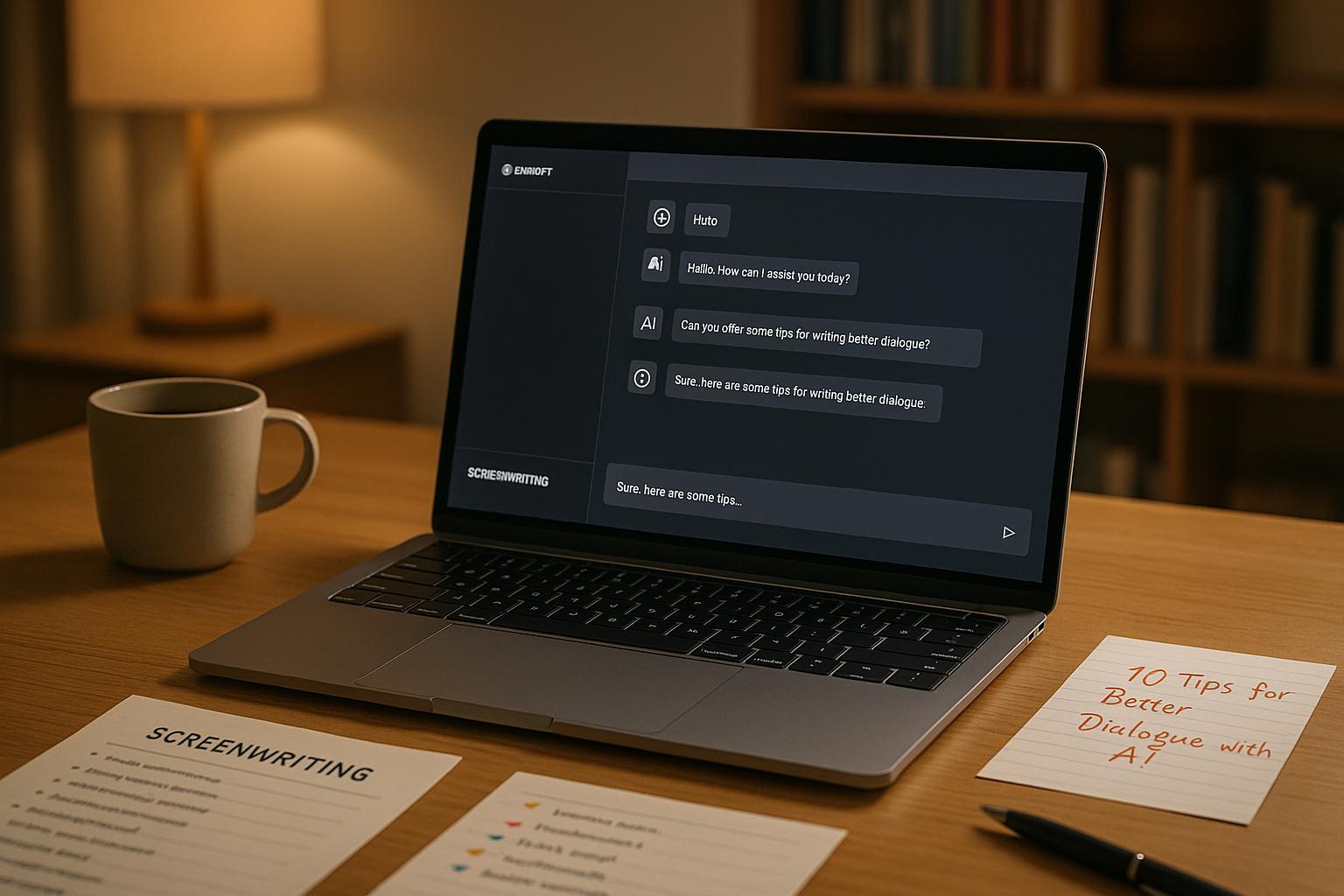
- Writing Realistic Dialogue & ChatGPT Prompts for Authentic Conversations
- 1. Set Clear Goals for Your AI Work
- 2. Give the AI Character Details and Context
- 3. Write Specific Prompts with Clear Limits
- 4. Improve Through Multiple Rounds
- 5. Focus on Character Voice and Natural Speech
- 6. Use AI for Subtext and Conflict
- 7. Test Different Versions and Compare Results
- 8. Get Professional Script Analysis with AI Tools
- 9. Don't Rely Too Much on AI-Generated Dialogue
- 10. Keep Creative Control of Your Work
- Conclusion
- FAQs
When using AI for dialogue writing, the goal is to enhance your process without losing the human touch. Here’s how you can collaborate with AI tools effectively:
- Set Clear Goals: Define what you need - better pacing, subtext, or distinct character voices. Be specific to get precise results.
- Provide Character Details: Share detailed profiles, including personality, background, and context, to guide AI in generating relevant dialogue.
- Write Specific Prompts: Use clear, structured prompts with constraints like tone, word count, or style to refine AI output.
- Iterate and Refine: Don’t settle for the first draft. Use multiple rounds of feedback to improve dialogue quality.
- Focus on Natural Speech: Ensure characters have unique voices by tailoring vocabulary, tone, and rhythm.
- Add Subtext and Conflict: Use AI to craft layered conversations that reveal hidden tensions or unspoken motives.
- Test Variations: Experiment with different versions of a scene to find the best fit for your story.
- Leverage AI Analysis Tools: Use platforms like AIScriptReader for quick feedback on pacing, tone, and dialogue consistency.
- Avoid Over-Reliance on AI: Use AI as a starting point but rely on your instincts to add emotional depth and originality.
- Maintain Creative Control: Treat AI as a collaborator, not a replacement, and ensure the final output aligns with your vision.
Writing Realistic Dialogue & ChatGPT Prompts for Authentic Conversations
1. Set Clear Goals for Your AI Work
Before diving into AI for dialogue writing, take a moment to define your objectives. Clear goals transform AI into a purposeful writing partner that aligns with your creative vision.
Pinpoint the specific challenges you're facing - whether it's nailing a character's unique voice, improving pacing, adding subtext, or exploring alternative dialogue options. These focus areas will shape how you use AI in your process.
For maintaining consistent character voices, let AI analyze the dialogue patterns of each character. If pacing or flow feels off, AI can review your scenes and provide actionable suggestions to refine rhythm and timing. Need variety? Use AI to generate multiple dialogue options, giving you a range of tones, emotions, and dynamics to work with.
AI tools can also help you ensure structural consistency across scenes, especially in longer scripts. Tracking character voices manually over dozens of pages can be overwhelming, but AI can streamline this process by offering precise feedback on tone, pacing, and overall coherence.
The secret lies in being specific. Instead of asking AI to "improve the dialogue", clarify what you're aiming for. Do you want more natural conversations? Heightened conflict? Clearer distinctions between characters? Sharper subtext? This level of detail ensures that your AI sessions are productive and results-focused.
Finally, document your goals and the key scenes you want to refine before each AI session. A little planning goes a long way in ensuring that the AI-generated content serves your story and moves it closer to your vision.
2. Give the AI Character Details and Context
To generate authentic dialogue, AI thrives on detailed character profiles. Without adequate context, its output tends to feel flat or generic.
Start by including the character's name in all caps along with their age (e.g., SUSAN (25-30)), a standout physical trait, and a concise description (e.g., "Uses secrets as currency"). These specifics help shape the character's voice and personality. But don’t stop there - consider the broader context around the character to further refine the AI’s responses.
"A character description is the literal introduction of a character in a screenplay. It's the first time the reader comes across this character, so it provides brief information about them, their name, age, and a brief physical description."
- Victoria Lucia, Screenwriter and Digital Content Creator
Context isn’t just about individual traits; it also involves situational and narrative elements. In December 2024, Beverly Nault and Jessica Brown of the Phoenix Screenwriters Association showcased how assigning an AI a specific identity significantly improved its output. By labeling the AI as "a prolific screenwriter with major awards", they guided it to craft secondary character arcs and meet professional storytelling standards.
"First, I give my AI an identity. By doing this I direct AI to a particular area of its universe, so its responses are more concise to what I am looking for."
- Jessica Brown, Phoenix Screenwriters Association
Additionally, define the setting clearly - time, place, and emotional tone. A conversation in a hospital waiting room will naturally differ in tone and urgency from one in a lively coffee shop. Establish relationship dynamics and the purpose of the scene, whether it’s a heated confrontation, a heartfelt reconciliation, or an exchange of critical information.
Spending time on these details upfront not only makes the AI’s output more nuanced but also speeds up your writing process by reducing the need for extensive rewrites. It’s an investment that pays off in the authenticity and depth of your screenplay dialogue.
3. Write Specific Prompts with Clear Limits
Getting precise and meaningful AI dialogue starts with crafting specific prompts. When your request is vague, the AI tends to generate generic responses. But with clear, well-structured prompts, you can guide the AI toward producing dialogue that feels more natural and purposeful.
Begin by defining your characters. Include details like their background, education, personality traits, and even their current emotional state. Then, set the emotional tone for the scene - whether it’s tense, lighthearted, somber, or urgent. Finally, outline the purpose of the interaction. What does each character want to achieve in the conversation?
Adding constraints can also refine the output. For example, you can limit the word count, specify a writing style, or include formatting preferences. Want something concise and stylized? Try a prompt like: “Write a 200-word dialogue in a noir style, with overlapping speech and interruptions.” These boundaries help sharpen the AI’s focus and produce more tailored results.
Here’s an example of a well-crafted prompt: “Write a 150-word conversation between MARCUS (30s, ex-military, guarded) and ELENA (20s, optimistic art student) in a hospital waiting room. Marcus has just learned bad news about his father, and Elena is unsure how to comfort him. The tone should be awkward but caring, with Marcus deflecting through humor.” Notice how this prompt combines context, character details, tone, and clear limits to create a strong foundation for the dialogue.
Think of AI as your creative partner. Provide enough context to ground the scene and let the AI explore unique scenarios that reveal more about your characters. Then, refine the results through iterative adjustments, as explained in the next sections.
4. Improve Through Multiple Rounds
Refining AI-generated dialogue is an ongoing process that thrives on iteration. The first draft is rarely the final product you'll want to keep. By revisiting and refining through multiple rounds of prompts, you can shape the dialogue into something that aligns with your creative vision.
Each round serves as a quality check, helping you identify and fix inconsistencies, gaps in logic, or lines that just don’t feel authentic. The AI’s initial response provides a starting point, but it’s through these iterative revisions that you can add depth, resolve issues, and make the characters' voices more genuine.
Begin with broad prompts to establish the foundation of the dialogue. Then, use follow-up prompts to zoom in on specific areas that need improvement. For instance, the first draft might nail the structure, but if the characters sound too similar, your next prompt could focus on making their voices more distinct. You might say, "Make Marcus's speech more casual by using contractions and shorter sentences."
When providing feedback, be as specific as possible. Vague instructions like "make it better" won’t yield the best results. Instead, offer clear guidance. For example, if the dialogue misses an emotional nuance, point it out directly: "Elena feels too confident here. She’s never dealt with grief before, so her dialogue should include more pauses and hesitant wording."
5. Focus on Character Voice and Natural Speech
Creating distinct character voices with AI involves more than just crafting dialogue - it’s about making each character feel like a real person with their own quirks, background, and way of speaking. To achieve this, you need to provide the AI with detailed, specific information about each character.
Start by offering clear examples of how each character speaks. For instance, an executive might use short, precise sentences, while someone from a small town might say something like, "Well, I reckon that engine’s seen better days, but she’s got some life left in her yet." These unique speech patterns help establish a sense of individuality.
"A noble character might use formal, complex sentences, while a street-smart individual might prefer slang and directness. This diversity in dialogue not only adds realism but also reflects each character's unique background." - Chris Rodgers
When working with AI, it’s helpful to remind it of a character’s backstory. Details like education, upbringing, profession, and even unique habits can shape their voice. Someone who didn’t finish high school will likely speak differently than a literature professor, just as a Boston native might choose different expressions than someone from rural Texas.
Pay attention to sentence structure and pacing. Some characters might speak in short, punchy sentences, while others prefer long, flowing dialogue. For instance, you could prompt the AI with something like, "Make Sarah’s dialogue more hesitant - she’s nervous about confronting her boss, so she should use more filler words and incomplete sentences." This lets the AI adjust the rhythm and tone to fit the character’s emotional state.
Vocabulary is another important factor. A teenager and their grandmother won’t use the same words, and a doctor discussing a medical emergency will sound very different from a mechanic explaining a car issue. Providing examples of vocabulary choices helps the AI fine-tune each character’s speech.
Adding stage directions can further enhance realism. For example, noting that a character is hiding their anger might lead the AI to include pauses or subtle shifts in tone. These directions can guide the AI to create dialogue that feels more natural and emotionally nuanced.
Finally, consistency is key. Once you’ve established a character’s voice, it’s important to maintain it throughout the script. The AI can reference earlier dialogue examples to ensure each character remains distinct and true to their personality. This attention to detail is what brings characters to life and keeps your story engaging.
sbb-itb-44d62f7
6. Use AI for Subtext and Conflict
Great dialogue isn't just about what characters say - it's about what they don't say. The most gripping conversations often hide unspoken tensions or secret motivations beneath the surface. This is where AI can come in handy, helping you craft layered interactions that keep readers or viewers hooked.
To get the most out of AI for creating subtext, start by providing clear context about your characters' relationships, emotional states, and hidden agendas. For instance, you could share that Sarah is secretly in love with her best friend's boyfriend, or that Marcus is hiding financial troubles from his business partner. This kind of background information allows AI to generate dialogue where characters hint at their true feelings or conflicts without explicitly stating them.
"Tension is just putting a narrative question in the audience's mind and not immediately answering it. The more potentially life-altering the question is, the more tension you can draw from it."
AI tools can also analyze your dialogue and suggest ways to heighten conflict or add subtle disagreements. For example, in a casual conversation about weekend plans, the AI might suggest including hints that one character is planning to leave town for good. Experiment by asking the AI to rewrite dialogue with different emotional undertones - sarcasm, flirtation, or mystery. A simple line like "That's interesting" can shift dramatically in meaning, depending on whether it’s delivered with genuine curiosity, quiet anger, or sly suspicion.
Another way AI can help is by flagging inconsistencies in your characters' behavior. If a character who’s usually confident suddenly becomes overly accommodating, the AI might point this out and suggest tweaks to keep their actions aligned with their personality.
Focus on interactions between characters with conflicting goals. Instead of having them state their intentions outright, let their hidden agendas shape their word choices, pauses, and what they choose to reveal - or conceal. AI can assist in brainstorming these underlying conflicts and weaving them into everyday conversations.
Secrets and lies are powerful tools for building tension in dialogue. If you provide the AI with details about what each character knows - or doesn’t know - it can craft conversations full of veiled threats, coded language, or insincere reassurances. This creates a richer, more engaging dynamic between characters.
"AI helps bring our own visions to life, but we humans are still better at creating stories that connect emotionally with people in ways that technology doesn't fully understand yet." - AiUpdatesNow Team
Finally, make sure your key scenes carry emotional weight without overloading the dialogue. AI can help you layer in subtle subtext while keeping the dialogue natural and consistent with each character’s voice. The result? Conversations that feel authentic, yet brimming with unspoken tension.
7. Test Different Versions and Compare Results
Creating multiple versions of a dialogue and comparing them can open up new creative possibilities, helping you find the lines that resonate most with your story. Instead of sticking with your first draft, try experimenting with different tones, word choices, and emotional nuances to see what clicks.
For example, craft 3–5 unique takes on the same scene. Each version could highlight a different angle - one might lean into humor, another could build tension, and a third might hint at romance. Imagine a simple coffee shop meeting between two characters. Depending on the focus, the interaction could feel playful and flirty, strictly professional, or charged with unspoken conflict. This variety gives you the chance to evaluate which version best serves your narrative.
When reviewing your dialogue options, keep a few key elements in mind. Ask yourself: Does each version maintain distinct character voices? Does it move the plot forward? Does it achieve multiple storytelling objectives?
"Bad exposition is like bad lighting. It exposes more than it illuminates." – Josh Friedman
Pay close attention to dramatic tension. Some versions may spell everything out, while others leave room for interpretation, encouraging the audience to connect the dots. As Billy Wilder famously said:
"Let the audience add up two plus two. They'll love you forever." – Billy Wilder
Another critical factor is natural speech. Reading the dialogue aloud can help you determine if it sounds believable. Sometimes, the most authentic lines aren’t the ones that follow perfect grammar rules.
It’s also worth studying how acclaimed screenwriters handle dialogue. For instance, Little Women uses overlapping dialogue to capture interruptions, while Inglourious Basterds masterfully builds suspense through lengthy conversations.
AI tools can make this process even more efficient. These tools analyze scripts and provide data-driven feedback, helping you refine your work. Research shows that AI-assisted analysis can improve script selection accuracy by 25% and cut revision time by 35%. What typically takes 10 days of traditional script coverage can now be done in just two hours. With these insights, you can fine-tune your dialogue to ensure it delivers clear emotional beats.
When comparing versions, focus on how each one shapes the scene’s emotional journey. The best dialogue doesn’t just sound good - it drives the story forward, even in quieter moments.
8. Get Professional Script Analysis with AI Tools
AI tools are revolutionizing how scripts are analyzed, especially when it comes to dialogue. These tools can pinpoint weaknesses in pacing, tone, and structure, offering actionable feedback that helps sharpen your characters' voices and elevate your dialogue.
Take AIScriptReader, for example - a platform specifically designed for filmmakers, screenwriters, producers, and studios. It offers two main services: Coverage Reports, which assess your script's strengths, weaknesses, and market potential, and Development Notes, which provide detailed suggestions for improvement. Built with input from award-winning producers and writers, AIScriptReader delivers feedback that meets industry standards.
While traditional script coverage can take up to 10 days, AI-powered analysis can provide an initial assessment in just two hours. Studios using these tools report a 25% increase in script selection accuracy and a 35% decrease in revision cycles.
For dialogue, these AI tools go beyond basic grammar checks. They analyze how your characters speak, identifying inconsistencies in voice, awkward phrases, or missed opportunities for subtext. The feedback also evaluates whether your dialogue effectively advances the plot, reveals character depth, and maintains dramatic tension.
Pricing is straightforward and accessible. A single Coverage Report costs $39, while a package including both Coverage and Development Notes is $69. For ongoing projects, subscription plans start at $50/month for 5 script credits and go up to $90/month for 30 script credits.
It's important to see AI feedback as a tool to guide your revisions, not replace your creative instincts. For instance, the AI might flag that a character's speech patterns shift unexpectedly in Act II or that a scene lacks the emotional weight needed to push the story forward. With this data-driven insight, you can address these issues before your script reaches producers or directors.
The process is simple: upload your script, let the AI analyze it, and receive a comprehensive report. This streamlined approach has reduced development costs by 30% across the industry, making professional-grade script analysis more accessible than ever. Whether you're a seasoned screenwriter or just starting out, these tools can help you refine your dialogue and ensure your script is pitch-ready.
9. Don't Rely Too Much on AI-Generated Dialogue
AI can certainly help generate dialogue based on character profiles, but it often misses the subtle emotional depth needed for truly impactful storytelling.
Bob Shaye, founder of New Line Cinema, captured this idea perfectly:
"AI might give you 10,000 variations of a script, but only a human knows how to make the audience cry at the right moment."
By 2025, nearly half of film professionals are expected to incorporate AI into their workflows. While this can streamline processes, it also introduces the risk of creating stories that feel formulaic and predictable. AI-generated dialogue often leans on clichés and generic phrases, which can dilute the originality of your work. As screenwriting coach John Smith points out:
"AI can put together a draft, but infusing soul into a script…for that, it's dreadfully inadequate."
The key is to treat AI-generated dialogue as a starting point, not the final product. Use it as raw material that you can refine and shape. Adjust the syntax, eliminate overused expressions, and add character-specific details that bring the dialogue to life. Your personal experiences, emotional insight, and creative instincts are what make your writing resonate with an audience in ways AI simply cannot replicate.
The most successful screenwriters understand this balance. They take AI's suggestions and enhance them with their own vision, ensuring the dialogue feels authentic and emotionally engaging.
10. Keep Creative Control of Your Work
While AI can be a powerful ally, the heart of storytelling remains in your hands. Your creative judgment is what turns ideas into unforgettable narratives. AI is a tool - one that can assist and enhance - but the vision and final say are yours.
"AI should be a tool to enhance your process, not replace your original work."
Start by defining your vision clearly. Outline the genre, tone, plot, and characters before diving into AI-assisted tasks. This framework acts as your creative guide, helping you evaluate whether AI-generated suggestions align with your story or veer off course. Think of AI as a collaborator, not a replacement.
"The AI doesn't come up with my stories for me - it helps me explore my own ideas more fully. I can rapidly test different approaches, voices, and scenarios in minutes rather than days. It's like having a tireless writing partner who helps me see my story from angles I might have missed."
Once the AI provides suggestions - be it dialogue, plot ideas, or scene outlines - it's up to you to refine and shape the output. Ask yourself: Does this dialogue feel authentic to my character? Does it contribute to the emotional arc of the story? Does it maintain the tone I envisioned? By filtering AI’s input through these questions, you ensure every line fits seamlessly into your narrative.
Use AI for the groundwork: brainstorming, structuring scenes, or drafting basic dialogue. Then, focus your energy on what AI can't replicate - emotional depth, character nuance, and the subtle layers that make stories resonate on a deeply human level. This iterative process - testing, refining, and tweaking - ensures the final product reflects your unique voice.
AI can amplify your creativity, but only when you remain firmly in the driver’s seat. Your personal experiences, insights, and artistic choices are what transform AI-generated ideas into dialogue and stories that leave a lasting impact. Keep refining until your work feels undeniably yours.
Conclusion
Screenwriting is changing, and AI is playing a growing role in that transformation. With global AI spending in the film industry projected to hit $886 million by 2024 - and 70% of major companies already integrating AI into their workflows - it's clear that these tools are becoming a staple. But while AI can refine dialogue and streamline processes, your creativity remains the driving force behind compelling stories.
This guide has highlighted how screenwriters can collaborate with AI to enhance their work. The key lies in balance: let AI handle structural tasks and generate variations while you focus on adding emotional depth and authenticity. As the creative director of your script, you ensure that the heart of the story remains human, even as AI supports the process.
Jane Rosenthal, co-founder and CEO of Tribeca Enterprises, puts it perfectly:
"Technology does not create a good story - humans do. But because of these technological innovations and new tools, the barrier to entry has shifted and there is room for everyone at the table".
The numbers back this up. In 2023, 23% of authors incorporated generative AI into their writing, and 79% of marketing professionals identified AI's ability to empower human creativity as its greatest benefit. Screenwriters are increasingly seeing AI not as a competitor, but as a collaborator - a tool to elevate their storytelling.
By blending AI's efficiency with your own creative insight, you can craft characters that feel alive, dialogue that connects, and narratives that resonate. As Chris Deering, former chairman and CEO of Sony Computer Entertainment, aptly states:
"AI cannot replace creative talent, but it can assist".
Your voice, perspective, and instincts are irreplaceable. Use AI to amplify these strengths, ensuring your scripts remain meaningful and impactful. For personalized feedback that aligns with your creative goals, tools like AIScriptReader (https://aiscriptreader.com) can help fine-tune your dialogue and bring your vision to life.
FAQs
How can I make sure AI-generated dialogue reflects each character's unique voice?
To make AI-generated dialogue truly reflect each character's unique voice, begin by offering specific, detailed descriptions of their personality, tone, and speaking style in your prompts. Include details like their choice of words, level of formality, or any distinctive habits or quirks that make them stand out.
Once the dialogue is generated, fine-tune it by reviewing and editing to ensure it aligns with the character's established traits. Reading the dialogue out loud is a great way to catch any inconsistencies and confirm that it feels natural and true to the character.
For extra support, tools like AIScriptReader can be incredibly helpful. They analyze your script and provide feedback to improve dialogue consistency and character portrayal.
How can I use AI tools to improve dialogue without losing my unique creative voice?
To make the most of AI while staying true to your creative style, think of it as a partner in the process, not a substitute. Use AI to help with tasks like brainstorming fresh ideas, suggesting alternative phrasing, or breaking through writer’s block. However, always take charge of the final product to ensure it reflects your unique voice and emotional tone.
Establish clear guidelines for how you use AI by crafting specific prompts that steer the tool in the right direction without overshadowing your creativity. Carefully review and tweak AI-generated suggestions to make them feel genuine and aligned with your work. This way, AI becomes a tool to support your storytelling, not define it.
How can AI tools like AIScriptReader enhance the pacing and tone of dialogue in a screenplay?
AI tools like AIScriptReader bring a new level of refinement to dialogue by carefully analyzing pacing and tone. They can identify when a scene drags on too long or when dialogue feels rushed, offering practical suggestions to create a more natural and engaging flow. On top of that, these tools evaluate the emotional and stylistic aspects of dialogue, ensuring the tone remains consistent and that character voices stay true to the story's mood.
By handling these intricate details of script analysis, AI tools not only save time but also provide valuable insights. This allows screenwriters to craft dialogue that truly connects with audiences and enhances the overall impact of their screenplay.
Free Screenwriting Tools
Tools to use alongside your writing — no signup, no cost.
Free Screenplay Editor
Write and auto-format scripts in your browser. Cloud autosave, PDF & Fountain export.
Open tool →AI Script Breakdown
Upload a script and every scene is tagged with its production elements. $29 per script.
Open tool →Get a Full Coverage Report — $39
AI screenplay coverage and development notes in minutes. No subscription.