How AI Analyzes Character Voice Consistency
- Simple Way to Write Dialogue for Writers Using AI Tools
- How AI Analyzes Character Voice Consistency
- Key Metrics in AI Voice Consistency Analysis
- Practical Uses for Screenwriters
- Getting the Most from AI Feedback for Better Revisions
- Conclusion: Improving Screenplays with AI-Driven Insights
- FAQs
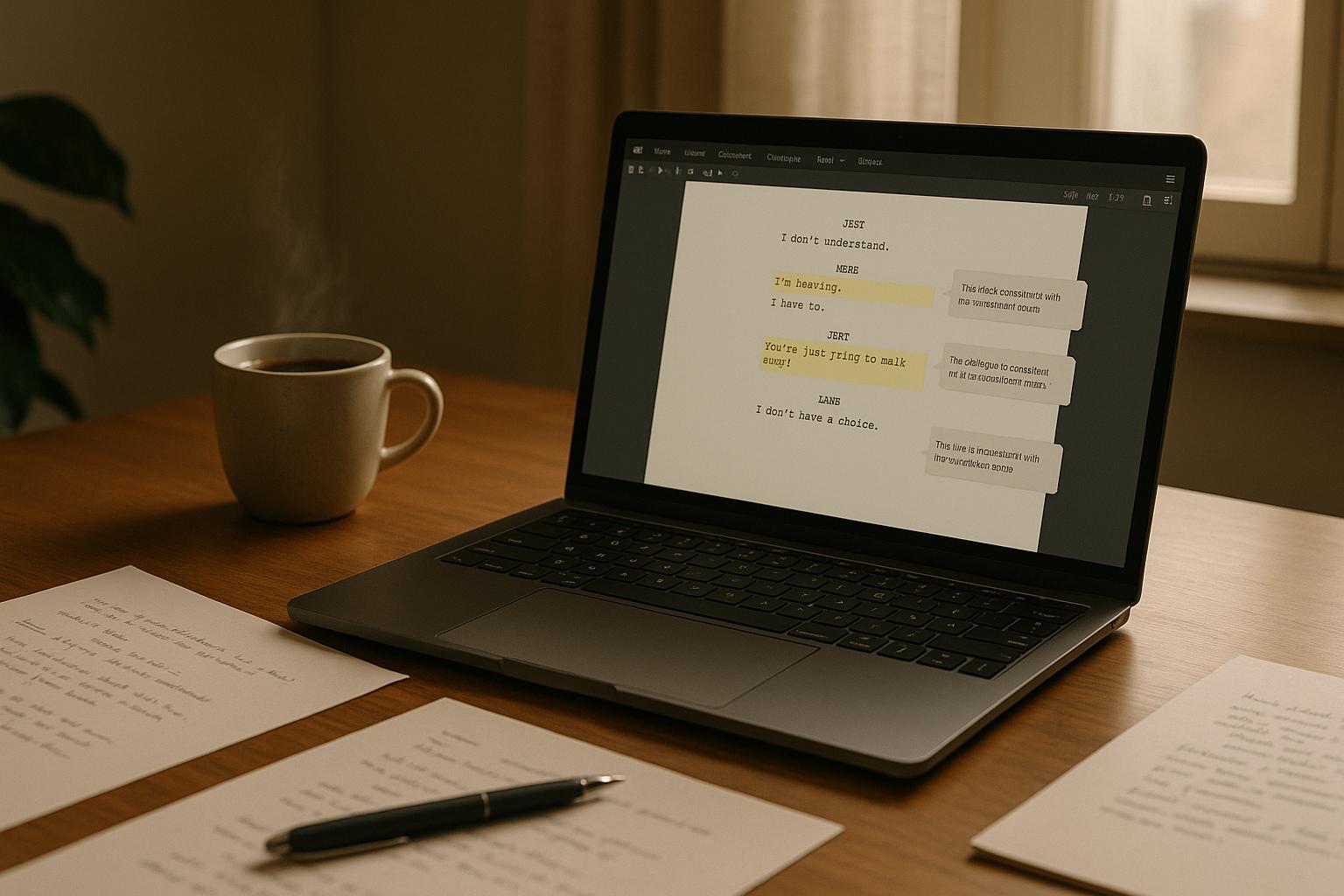
AI tools are transforming how writers maintain consistent character voices in screenplays. Here's how they work and why they matter:
- What AI Does: AI analyzes dialogue to create unique "voice profiles" for each character, focusing on vocabulary, sentence structure, and emotional tone.
- Why It’s Useful: It flags inconsistencies like shifts in tone or style, overused phrases, and unnatural dialogue.
- Key Metrics: Tools measure word variety, sentence structure, emotional markers, and overall consistency to ensure characters sound distinct and believable.
- Time-Saving: AI processes scripts in minutes, reducing revision cycles by up to 35%.
Using AI for first drafts, rewrites, or specialized characters (like those with accents or technical jargon) helps screenwriters focus on storytelling while ensuring their characters stay consistent and engaging. Tools like AIScriptReader make this process fast and data-driven, but the writer’s creativity remains essential.
Simple Way to Write Dialogue for Writers Using AI Tools
How AI Analyzes Character Voice Consistency
AI brings a detailed, methodical approach to evaluating character voice consistency, diving deep into the nuances of dialogue and character traits using advanced machine learning techniques.
Creating a Language Profile for Each Character
To start, AI assigns a unique "voice fingerprint" to each character in your script. This goes well beyond counting words - it’s about dissecting the language, grammar, vocabulary, and descriptions that define a character's personality, background, and emotional tendencies. The system looks at factors like:
- Vocabulary complexity: Does the character use simple, everyday language or lean toward more sophisticated phrasing?
- Sentence structure: Are their thoughts expressed in short, abrupt phrases or long, elaborate sentences?
- Emotional language markers: How do they express feelings or react in conversations?
By analyzing word frequency, context, and usage, AI captures the subtle traits that make each character unique, ensuring their voice aligns with their identity and role in the story.
Finding Voice Pattern Problems
Once the voice fingerprint is established, AI shifts its focus to identifying issues. It flags overused phrases, awkward dialogue exchanges, and shifts in tone or style that don’t align with the character's established voice. For example, it might catch an abrupt change where a character suddenly switches from casual to formal language without a clear reason in the narrative. By examining linguistic patterns and tone, AI ensures that each character’s voice remains consistent and believable.
Considering Context and Character Growth
AI doesn’t stop at static analysis; it also evaluates dialogue within the broader context of the story. It tracks each character’s development from start to finish, distinguishing between intentional growth and accidental inconsistencies. For instance, if a shy character suddenly becomes confrontational without a logical buildup, the system flags it. However, it also recognizes when gradual changes fit the story’s arc.
Additionally, AI considers situational context - acknowledging that a character might speak differently in a formal setting, like a job interview, compared to casual moments with friends. It also tracks how characters interact during key thematic moments, ensuring their behavior aligns with the story’s emotional beats. This layered analysis helps writers fine-tune their characters, maintaining authenticity while allowing for natural evolution.
Key Metrics in AI Voice Consistency Analysis
AI tools rely on measurable metrics to evaluate how consistently each character's voice is portrayed throughout a screenplay. This data helps screenwriters pinpoint weak spots in dialogue and track improvements over time.
Word Variety and Sentence Structure Analysis
One key metric is vocabulary diversity. The AI calculates how many unique words a character uses in relation to their total dialogue. Characters who frequently repeat phrases or rely on a limited vocabulary score lower here. The tool also evaluates sentence structure, looking at dialogue length, the balance between questions and statements, and grammatical patterns. For instance, a street-smart teenager might use fragmented sentences and slang, while a professor might favor more formal, complex grammar. If these patterns shift unexpectedly, the AI flags the inconsistency.
The analysis goes further by examining emotional language. It checks that expressions - like short, clipped sentences for anger or long-winded rants - stay consistent across the script. This ensures emotional tone aligns with the character's established voice.
How Different Each Character Sounds
Building on word variety and structure, the AI assesses how distinct each character's voice is compared to others. It generates a voice differentiation score by analyzing vocabulary overlap, dialogue rhythm, and pacing. This ensures each character has a unique way of speaking.
Another metric, Character Error Rate (CER), measures how much a character's dialogue would need to be adjusted to match their established voice. This is especially useful for spotting deviations when characters use specialized jargon or formal language.
Character Consistency Scores
AIScriptReader offers an overall consistency score for each character, expressed as a percentage from 0% to 100%. This score combines factors like vocabulary use, sentence structure, emotional tone, and context. It highlights inconsistencies, such as a protagonist maintaining a steady voice early in the story but faltering during a pivotal scene. Writers can use these scores to prioritize revisions and strengthen the narrative flow.
Consistency in character voice is essential for keeping audiences engaged and ensuring the story feels authentic. When dialogue strays from a character's established voice, it risks confusing viewers and weakening the story's impact. By turning the subjective evaluation of dialogue into a measurable process, AI tools give writers clear, actionable targets to refine their scripts. These metrics make it easier to maintain authentic and compelling character voices.
sbb-itb-44d62f7
Practical Uses for Screenwriters
AI voice consistency tools are transforming how screenwriters refine dialogue, offering focused feedback that saves time and effort. Instead of painstakingly reviewing every page to catch inconsistencies, writers can now rely on AI to pinpoint problem areas, allowing them to concentrate on what matters most - crafting compelling stories.
Using AI for First Draft Reviews
First drafts are often a breeding ground for dialogue inconsistencies. Characters might start with one voice but shift as the story evolves or after breaks in the writing process. AI tools excel at analyzing dialogue patterns across the entire script, quickly identifying where inconsistencies crop up. This means writers can address these issues early - within hours - before they become deeply woven into the story's structure.
Making Character-Specific Rewrites Easier
AI doesn't just stop at flagging inconsistencies; it also simplifies the process of revising individual characters. By generating detailed reports for each character's dialogue, these tools allow writers to focus on one voice at a time without constantly flipping between characters. This targeted approach makes rewrites more efficient and ensures every character maintains a distinct and authentic voice.
For example, AI can spot lines where dialogue feels unnatural or out of place and even suggest alternatives that better align with the character's personality. It can also generate variations of a scene’s dialogue, helping writers explore different emotional tones or interactions to find the most authentic expression. That said, it’s crucial for writers to see AI suggestions as a starting point rather than a final solution. The writer’s unique voice and creative vision should always guide the final decisions.
Keeping Specialized Characters Accurate
When it comes to characters with specific backgrounds - like a 1940s detective, a medical examiner, or someone with a strong regional dialect - maintaining authenticity can be tricky. This is where AI really shines. By training the technology on specific genres or scripts, writers can ensure that dialogue reflects the right cadence, vocabulary, and tone.
For historical pieces, AI can help maintain period-appropriate language, while for professional characters, it ensures technical jargon stays consistent and accurate. Writers can even create comprehensive style guides, including character bios, world-building rules, and unique dialogue traits, to train the AI further. This is especially useful for ensemble casts, where every character needs a distinct voice that aligns with their background.
AI can also analyze previous drafts and character arcs, offering suggestions for alternative word choices, emotional nuances, or subtext that enhance authenticity. For characters with accents or regional dialects, AI can help strike the right balance - suggesting when to lean into specific expressions and when to pull back for clarity. This ensures the dialogue feels genuine without alienating the audience.
Getting the Most from AI Feedback for Better Revisions
AI feedback can be incredibly helpful, but it’s most effective when approached thoughtfully. Instead of simply accepting every suggestion, focus on understanding the insights it offers and use them to guide your creative decisions.
How to Review and Prioritize Problems
When AI highlights inconsistencies in character voice, not all flagged issues carry the same weight. For example, if a laid-back character suddenly speaks with overly formal language, that’s worth addressing. Start by considering the narrative context and reviewing the AI's consistency scores to pinpoint key problem areas. This way, you can separate genuine issues that need fixing from intentional character development that aligns with your story. Let the AI’s insights inform your revisions, but always balance them with your creative intent.
Balancing AI Feedback with Your Own Judgment
Once you’ve identified potential issues, remember that AI is a tool, not a replacement for your creativity. Use its feedback as a foundation for deeper analysis, tweaking suggestions to fit your story’s unique voice and character arcs. While AI is excellent at identifying patterns and technical details, it lacks the ability to capture the emotional depth and authenticity that human creativity brings. Always prioritize emotional resonance and stay true to your narrative vision when deciding which recommendations to implement.
Creating Character Voice Guides
To maintain consistency across drafts, create detailed voice guides for your characters. AI tools can help by analyzing dialogue and identifying patterns. Use this information to document each character’s vocal traits - such as tone, speed, pitch, and signature phrases. These profiles can then serve as a reference point for ensuring new dialogue aligns with established voices. This approach is especially useful for ensemble casts or long-term projects with multiple revisions.
For a streamlined process, consider tools like AIScriptReader (https://aiscriptreader.com). It offers detailed character analysis and provides actionable insights through its Development Notes, helping you refine and maintain consistent character voices.
Conclusion: Improving Screenplays with AI-Driven Insights
AI-powered tools are changing the way screenwriters approach their craft, especially when it comes to maintaining character voice consistency. Studios using AI-driven script analysis have reported measurable improvements in their workflows, showing how these tools can make a real difference in the creative process.
One of AI's standout advantages is the speed it brings to script reviews. Tasks that traditionally took hours - or even days - can now be completed in just minutes. For instance, Paradigm Talent Agency reduced their script coverage time by over 95% with the help of AI analysis. This efficiency frees up writers to focus on the creative aspects of storytelling, like crafting compelling characters and refining dialogue.
AI also shines in collaborative environments, especially on projects involving multiple writers. It ensures that character portrayals remain consistent across drafts and contributors, a challenge that often grows as scripts undergo revisions. By maintaining this consistency, AI helps preserve the integrity of characters throughout the writing process.
Industry professionals are taking notice of these benefits. Producer Paul Myerberg shared his perspective on the value of AI tools:
"If you can't make your script at least 30% better with ScriptReader.ai, you're not doing your job as a writer. In terms of value, no other solution comes close." - Paul Myerberg, Producer, Actor, Art Department
However, it's important to see AI as a collaborator, not a replacement. Filmmaker Ava DuVernay captures this sentiment perfectly:
"AI is a powerful lens, but human insight is the light that brings a story into focus."
Writers who embrace AI tools often find that their creativity is enhanced, not diminished. The trick is to combine AI's analytical strengths with your own artistic instincts. By using technology to support rather than replace your vision, you can achieve a balance that elevates your storytelling.
For those ready to explore this approach, platforms like AIScriptReader make it easy. With a simple three-step process - upload, analyze, and receive actionable feedback (https://aiscriptreader.com) - writers can access detailed character analysis through tools like Coverage Reports and Development Notes. These insights integrate seamlessly into the writing process, all while keeping you in full control of your characters' voices.
At its core, storytelling remains a deeply human endeavor. AI simply provides the tools to help you refine your craft with greater clarity and consistency. It’s not about replacing creativity - it’s about giving it the support it needs to thrive.
FAQs
How does AI help ensure character voice changes reflect intentional development instead of inconsistencies?
AI tools such as AIScriptReader are designed to evaluate character dialogue and interactions, focusing on whether shifts in voice are intentional and align with a character's development. By examining patterns in language, tone, and emotional expression, the AI determines if a character's voice stays true to their established personality and story arc.
For instance, if a character's dialogue suddenly changes in tone or style without a clear narrative reason, the AI flags it for further review. This gives writers the chance to adjust the script, ensuring that any shifts in voice reflect meaningful character growth or transformation rather than accidental inconsistencies. This process not only keeps characters authentic but also strengthens the overall flow of the story.
How can AI help screenwriters create characters with unique accents or technical language?
AI offers screenwriters a powerful tool for refining dialogue, especially when crafting characters with distinct accents or specialized language. By leveraging natural language processing (NLP) and machine learning, AI can analyze speech patterns to help writers capture the subtle intricacies of an accent or the exact phrasing of technical jargon. This ensures the dialogue feels authentic and true to the character.
Beyond that, AI can suggest tweaks to enhance the flow, clarity, and emotional impact of conversations. This not only streamlines the writing process but also allows screenwriters to concentrate on the bigger picture - crafting compelling stories - while ensuring their characters sound genuine and culturally accurate.
How can writers use AI suggestions while staying true to their characters' voices?
AI can be a helpful assistant when it comes to improving your writing, but your creative instincts should always take center stage. Think of AI-generated suggestions as tools to fine-tune aspects like tone or dialogue, rather than something to fully rely on. It’s your vision and imagination that bring your characters to life.
To keep your work genuine, compare what the AI suggests with your original ideas. This lets you pinpoint where your unique voice shines through. You can also pair AI input with feedback from trusted friends or colleagues to ensure your characters feel relatable and emotionally engaging. At the end of the day, AI is there to enhance your creativity, not take its place.
Free Screenwriting Tools
Tools to use alongside your writing — no signup, no cost.
Free Screenplay Editor
Write and auto-format scripts in your browser. Cloud autosave, PDF & Fountain export.
Open tool →AI Script Breakdown
Upload a script and every scene is tagged with its production elements. $29 per script.
Open tool →Get a Full Coverage Report — $39
AI screenplay coverage and development notes in minutes. No subscription.