How AI Scores Genre Adherence in Scripts
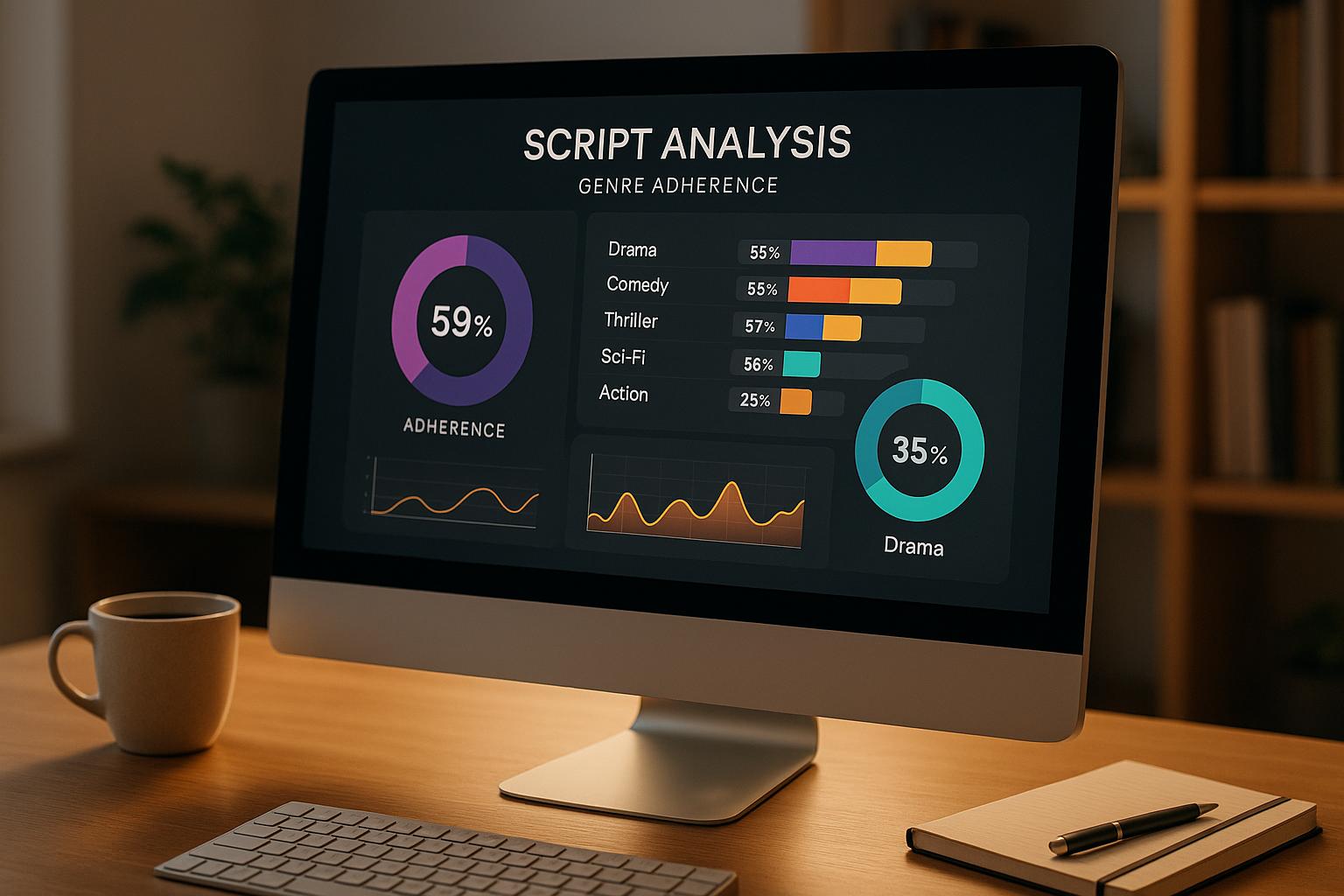
- Largo.ai Script Analysis and Success Forecasting
- How AI Analyzes Genre Adherence
- Step-by-Step Process for AI Genre Scoring
- Applications of AI in Script Development
- How AIScriptReader Scores Genre Adherence
- Conclusion
- FAQs
AI is changing how scripts are analyzed, making it faster and more accurate to align screenplays with genre expectations. Here's how it works:
- Why It Matters: Scripts that follow genre conventions are more likely to connect with audiences and succeed commercially. AI helps ensure scripts meet these standards, making marketing and production decisions easier.
- How It Works: AI tools analyze story structure, character arcs, pacing, and dialogue using Natural Language Processing (NLP). These tools compare scripts to successful examples in their genre.
- Benefits: AI saves time by automating analysis, reduces production risks, and provides actionable feedback for improving scripts before costly rewrites.
- Real Results: Studios like Warner Bros. have used AI to improve script selection accuracy by 25% and reduce box office flops by 20%.
AI tools like AIScriptReader deliver fast, detailed feedback, helping writers refine their work and align it with audience expectations in just one hour.
Largo.ai Script Analysis and Success Forecasting

How AI Analyzes Genre Adherence
AI evaluates scripts by examining language patterns and narrative structures, comparing them to established genre norms. This multi-layered analysis allows for a detailed breakdown of script elements, ensuring they align with the expectations of specific genres.
Breaking Down Scripts with AI
At the heart of AI's script analysis capabilities lies Natural Language Processing (NLP), which enables machines to interpret and dissect the complexities of screenplays. Unlike basic keyword searches, NLP dives into storytelling elements like plot progression, character development, and dialogue styles.
The process starts with AI algorithms analyzing massive datasets of existing scripts and literature. This helps the system learn patterns tied to storytelling, such as pacing, tone, and stylistic markers unique to certain genres. For example, AI can identify whether a thriller maintains tension or if a romantic comedy delivers the expected witty banter.
Some platforms take this a step further by offering real-time feedback. Using NLP, they pinpoint plot holes, suggest scene additions, and even recommend dialogue tweaks to enhance character depth. This level of analysis ensures that scripts are broken down into their core elements while staying true to genre-specific expectations.
AI also examines two critical aspects of storytelling: specific setting details (like the environment and context) and key character drivers (such as motivations and catalysts). For instance, in a horror script, AI might look for isolated settings and nighttime scenes, paired with supernatural elements or vulnerable protagonists. These details help AI assess not just what happens in a script, but how well it aligns with the conventions of its genre.
Dialogue analysis is another area where AI excels. By studying patterns, sentiment, and character dynamics, AI evaluates whether interactions fit the genre. For example, does a thriller maintain tension in its dialogue? Does a romantic comedy feature the lively exchanges audiences expect? These insights ensure that scripts meet genre standards in every detail.
Matching Scripts to Genre Standards
Once a script is deconstructed, AI compares its components to established genre benchmarks. By analyzing elements like pacing, plot arcs, and character development, AI identifies how closely a script aligns with successful examples within its genre.
Warner Bros. provides a striking example of this process. The studio used AI to evaluate scripts, leading to some impressive results. One mid-budget film identified by AI exceeded expectations, delivering a 30% higher ROI than traditional analysis had predicted. In another instance, AI flagged a high-budget film as risky due to weak story elements. After reworking the script based on AI's insights, audience test scores improved by 40%.
These outcomes highlight AI's ability to spot deviations from genre norms that could impact a film's success. More importantly, AI evaluates whether those deviations enhance or detract from the script's overall appeal. The technology has proven its worth across the industry - Warner Bros. reported a 25% improvement in script selection accuracy and a 20% reduction in box office flops using AI. Over two years, this approach helped the studio cut financial losses from underperforming films by 20%.
Predicting Audience Expectations
Beyond structural analysis, AI also predicts how audiences might respond to a script. By analyzing genre patterns, AI ensures that scripts align with viewer expectations, focusing on both obvious and subtle elements that drive satisfaction.
This predictive capability extends to settings, characters, and catalysts, helping gauge whether a script will resonate with its intended audience. A study by Comcast Technology AI, in collaboration with George Washington University, showcased this potential. Researchers used a language model to analyze metadata from unreleased films - such as cast, genre, synopsis, and awards - creating ranked lists of likely future hits.
AI also evaluates character arcs, plot structure, and adherence to genre conventions to forecast a movie's box office potential. By identifying underdeveloped characters or weak plotlines, AI helps writers refine their work, offering a clearer view of strengths and areas for improvement.
These insights allow writers and producers to make informed decisions. AI can even craft synopses tailored to a script's genre, ensuring marketing materials match the tone and style of the actual content. In essence, AI acts as an early warning system, flagging potential audience reception issues before costly production begins.
The benefits are clear: AI-driven script analysis not only aligns creative projects with audience expectations but also reduces risks. Research published in 2021 found that using AI tools for script analysis could cut financial risks and revision time by approximately 30%.
Step-by-Step Process for AI Genre Scoring
When it comes to evaluating scripts for how well they align with a specific genre, AI follows a structured, three-phase process. This approach turns raw screenplay text into meaningful insights, ensuring a thorough and consistent review across various genres and script types.
Script Upload and Analysis
The first step starts with writers uploading their scripts to an AI platform. These platforms typically support formats like PDF, Final Draft, and plain text files, making it easy for writers to get started.
Once the file is uploaded, the AI begins by breaking down the screenplay into its core components - dialogue, action lines, character names, and scene headings. This step helps the system grasp the script's basic framework before diving deeper.
Next, the AI applies Natural Language Processing (NLP) to analyze the script’s language, dialogue, and narrative flow. It catalogs key elements such as how characters interact, the pacing of the story, and tonal markers. These details are then compared to benchmarks for the target genre.
The system also conducts contextual analysis at this stage. It identifies critical details like the setting, time period, and character archetypes, creating a detailed profile of the script. This foundational analysis is fast, often completed in just minutes.
Automated Scoring and Feedback Creation
After the initial breakdown, the AI moves into the scoring phase. Here, it evaluates how the script stacks up against established genre standards. This involves comparing elements like plot, character development, dialogue, and pacing to databases of successful scripts within the same genre.
The scoring process looks at multiple aspects simultaneously. For example:
- Plot structure is assessed to see how well it follows the typical progressions of the genre.
- Character development is evaluated to ensure it aligns with what audiences expect.
- Dialogue is analyzed for authenticity, making sure it fits the tone and style of successful examples.
Industry case studies have shown that this kind of AI scoring can catch issues that traditional script analysis might miss, giving writers a significant advantage. The system also flags potential problems early, helping writers avoid costly mistakes during production.
Providing Actionable Insights
In the final phase, the AI transforms its findings into practical recommendations that writers can use right away. Instead of just pointing out flaws, the system offers specific suggestions for improvement, complete with examples and alternative approaches.
Writers receive detailed reports that break down each element of their script. For instance, if the dialogue lacks tension suited to the genre, the AI will suggest ways to improve it. If character arcs don’t meet genre standards, the system provides clear recommendations for adjustments, explaining the reasoning behind each one.
The feedback goes beyond surface-level fixes. The AI also provides strategic advice for market positioning, helping writers understand whether deviations from genre norms strengthen or weaken the script’s commercial appeal.
"This is the most revolutionary tool for screenwriters since screenwriting software was invented. It looks at things I never thought were even something to be paid attention to, and now I go back to every scene I thought was brilliant and realize it could still be better." - Kevin Birnbaum, Writer, Director, Editor
What sets this AI apart is its ability to deliver specific, actionable feedback. Writers don’t just get criticism - they get a roadmap for improvement, complete with genre-specific examples and strategies that have been tested in the market.
With these insights in hand, the next section explores how AIScriptReader simplifies the process of scoring genre adherence through its streamlined workflow.
sbb-itb-44d62f7
Applications of AI in Script Development
AI is reshaping script development by turning detailed insights into practical improvements at every stage of the process. With 40% of media companies planning to use AI for content creation by 2026, the technology is already proving its worth. Generative AI tools, for example, can reduce production planning time by as much as 60%.
Improving Script Quality
AI tools excel at identifying weaknesses in scripts, such as underdeveloped characters or plotlines, by comparing them to successful screenplays. Writers can use these insights to ensure their characters stay consistent and believable throughout the story, resulting in stronger character arcs.
By analyzing traits from thousands of hit movies and TV shows, AI helps refine character development and even suggests authentic dialogue that aligns with genre expectations while advancing the plot. Studios using AI-powered script analysis report a 25% boost in script selection accuracy and a 35% reduction in revision cycles. This means writers and creative teams can spend more time crafting compelling stories instead of repeatedly fixing structural issues. AI also uncovers industry trends and patterns that might go unnoticed by human readers, offering objective data to guide creative choices.
"If you can't make your script at least 30% better with ScriptReader.ai, you're not doing your job as a writer. In bang for the buck, there's nothing even close." - Paul Myerberg, Producer, Actor, Art Department
Reducing Development Risks
AI dramatically speeds up early problem detection, cutting assessment time from 10 days to just 2 hours. This allows development teams to address potential issues before they escalate into costly production challenges.
The technology also helps mitigate risks by identifying legal vulnerabilities and ensuring safety protocols are met. For instance, AI can flag scenes requiring specialized equipment, stunt work, or specific safety measures, enabling teams to prepare accordingly.
AI’s ability to analyze audience preferences from social media, streaming platforms, and box office trends makes market alignment more predictable. It can forecast which genres, themes, or story elements are likely to succeed in specific markets, helping studios tailor their scripts and marketing strategies. This data-driven approach has led to a 30% reduction in development costs for studios using AI-powered analysis. A notable example is ScriptBook’s AI system, which accurately predicted the financial success of La La Land before its release by analyzing its plot, characters, and dialogue.
Making Rewrites More Efficient
Rewrites can be a daunting phase, but AI simplifies the process by pinpointing key issues like inconsistent dialogue, uneven screen time, or plot gaps. It tracks plot elements and character details throughout the script, ensuring nothing is overlooked. For example, it can highlight scenes where dialogue lacks the tension expected for a specific genre or where character arcs fail to meet audience expectations, offering clear guidance for revisions.
AI doesn’t just stop at surface-level fixes. It can track specific objects or details across the script, ensuring continuity and proper setup for critical plot points. This level of precision helps writers produce polished drafts more efficiently than traditional methods.
The benefits of AI grow with each draft. Its analysis remains consistent across revisions, giving writers reliable benchmarks to measure progress. This consistency helps creative teams determine when a script is truly production-ready, reducing the uncertainty that often delays development timelines. These improvements pave the way for AIScriptReader's streamlined 3-step workflow, which will be explored in the next section.
How AIScriptReader Scores Genre Adherence
AIScriptReader simplifies the process of analyzing scripts for genre-specific elements, delivering professional feedback in just one hour. By leveraging advanced AI, the platform evaluates scripts against established genre conventions, providing writers and producers with actionable insights to refine their work. This approach reflects the entertainment industry's growing reliance on efficient, data-driven tools for script evaluation.
AIScriptReader's 3-Step Workflow
AIScriptReader offers a streamlined, three-step workflow designed to make script analysis faster and more precise. Traditional script evaluations often involve lengthy and costly manual reviews, but this platform removes those barriers. Writers can easily upload their scripts through a secure dashboard, ensuring their intellectual property stays protected.
Once uploaded, AIScriptReader's proprietary algorithms analyze the script to determine how well it aligns with genre expectations. This automated approach replaces the time-consuming manual process, delivering results in just one hour. Users receive a detailed report through their dashboard, allowing them to quickly incorporate professional feedback without disrupting their creative flow.
"AIScriptReader is as good as it gets. This platform is truly remarkable and it will save you a ton of money. It will break your script down in a professional way and lay it all on the table for you in about 1 hour. Give it a go, you will truly be impressed."
– Brian Jewell, Producer, Writer, Actor
Key Features for Genre Scoring
AIScriptReader dives deep into genre-specific elements, going well beyond surface-level analysis. The platform evaluates key aspects such as tropes, character archetypes, and narrative structures that are essential for success within a specific genre. For instance, thriller scripts are assessed for their ability to build tension and maintain pacing, while romantic comedies are reviewed for comedic timing and the development of relationships.
The AI examines critical structural components - like the placement of plot points, character arc progression, and conflict resolution - by comparing them to established benchmarks for each genre. This process provides writers with clear, data-backed insights into how their scripts measure up to industry standards.
Rather than just highlighting problems, AIScriptReader offers targeted recommendations to help writers address weak spots while preserving their creative vision. This guidance ensures that feedback is both constructive and respectful of the writer's unique style.
Creating Detailed Reports
AIScriptReader goes a step further by offering comprehensive, tailored feedback through two types of reports: Coverage Reports and Development Notes.
- Coverage Reports focus on marketability, providing concise evaluations that include loglines, synopses, and overall script assessments. These are particularly valuable for producers and executives looking for commercially viable projects.
- Development Notes are designed to help writers improve their scripts. These detailed reports address areas like character development, dialogue quality, and structural issues, offering clear, actionable steps for revision.
By blending quantitative scoring with qualitative insights, AIScriptReader ensures that writers receive feedback on both the technical and creative aspects of their scripts. The reports not only evaluate genre adherence but also provide broader observations on narrative effectiveness, helping writers enhance both the artistic and commercial appeal of their work.
As AI continues to gain traction in the entertainment industry - where 40% of media companies are expected to adopt AI for content generation by 2026 - AIScriptReader equips writers with the tools they need to thrive in this evolving, data-centric environment. By balancing genre conventions with creative individuality, the platform supports writers at any stage of their careers.
Conclusion
Key Points on AI and Genre Adherence
AI is transforming the way scripts are developed by streamlining the analysis of genre adherence. It identifies trends and patterns that might escape human readers and ensures consistent evaluation without the influence of personal bias. By automating repetitive tasks, AI allows writers to dedicate more time to crafting compelling stories.
Recent data underscores the growing role of AI in script analysis: generative AI tools can cut production planning time by as much as 60%, and 40% of media companies are expected to adopt AI for content creation by 2026.
"AI is a powerful lens, but human insight is the light that brings a story into focus." - Ava DuVernay
These advancements highlight how tools like AIScriptReader are shaping the future of script refinement.
AIScriptReader as a Powerful Tool
AIScriptReader embodies these advancements by integrating cutting-edge AI methodologies to streamline script evaluation. The platform delivers fast, actionable insights through Coverage Reports, which assess marketability, and Development Notes, which guide script improvement.
Industry experts have praised its impact. Producer Paul Myerberg shares, "If you can't make your script at least 30% better with ScriptReader.ai, you're not doing your job as a writer. It offers unmatched value." Similarly, writer and director Kevin Birnbaum remarks, "This is the most revolutionary tool for screenwriters since screenwriting software was invented. It looks at things I never thought were even something to be paid attention to, and now I go back to every scene I thought was brilliant and realize it could still be better."
AIScriptReader showcases how AI-driven analysis can elevate both the creative and commercial aspects of screenwriting, all while honoring the writer's unique voice.
FAQs
How does AI evaluate if a screenplay aligns with its genre?
AI examines how well a screenplay aligns with its intended genre by focusing on critical elements like narrative structure, character types, themes, and stylistic features. For instance, it evaluates whether the pacing, dialogue, and plot developments fit the typical patterns of genres such as thrillers, comedies, or dramas.
It also spots recurring tropes and considers what audiences expect from each genre. By offering in-depth feedback, the AI helps writers fine-tune their scripts, making them more appealing to their intended audience and boosting their chances in the market.
How can screenwriters and studios benefit from using AI tools like AIScriptReader for script analysis?
AI tools like AIScriptReader bring a range of benefits to screenwriters and studios, making script analysis faster and more efficient. These tools can quickly pinpoint essential elements like character arcs, themes, and plot structures, cutting down on the time and effort spent on manual reviews. This means filmmakers can dedicate more energy to honing their creative vision.
On top of that, AI can offer fresh perspectives and suggestions, which can be especially helpful when writers hit a creative roadblock or want to explore new storytelling angles. By simplifying the development process and improving precision, these tools not only help trim production costs but also play a role in crafting films that are more engaging and polished.
How does AI analyze audience expectations, and how does this influence a film's success?
AI dives deep into audience expectations by sifting through massive datasets like social media trends, past box office numbers, and viewer preferences. By spotting patterns and uncovering insights, it gives filmmakers and studios a clearer picture of what themes, genres, or story elements strike a chord with audiences.
This kind of analysis can have a big influence on a film's success. For instance, AI tools can assess scripts to ensure they align with the intended genre and appeal to target viewers. With this information, creators can tweak their projects to better match audience tastes. Beyond the creative side, studios can also lean on AI to fine-tune marketing strategies, choose the best release dates, and even make smarter casting decisions - all of which boost the odds of a box office win.
Free Screenwriting Tools
Tools to use alongside your writing — no signup, no cost.
Free Screenplay Editor
Write and auto-format scripts in your browser. Cloud autosave, PDF & Fountain export.
Open tool →AI Script Breakdown
Upload a script and every scene is tagged with its production elements. $29 per script.
Open tool →Get a Full Coverage Report — $39
AI screenplay coverage and development notes in minutes. No subscription.